My sister just got a lower back tattoo that says "No Regrets." She does not seem to appreciate the potential for irony. That's too bad. In my book, that potential is the best reason to get such a tattoo.
A few years ago, the MIT Media Lab, working with the Comparative Media Studies program at MIT, created the Center for Future Civic Media. It's a great project and one I've been involved in since the beginning.
Not too long after, the lab announced the Center for Future Banking through a partnership with Bank of America. One couldn't help but notice the similarity between the names. The meme became further entrenched when, not too long after, the lab announced the Center for Future Storytelling in collaboration with Plymouth Rock Studios.
But perhaps the very first in the pattern is the the Okawa Center for Future Children announced in 1998 as a way of bringing together and supporting the labs work with kids. And no, it has nothing to do with zygotes.
As is becoming my custom, I'm planning to spend much of December and January on the road. This time I'll be in Seattle, Japan and Wellington, New Zealand. Here's the rough schedule:
Mika will also be around for everything but the NZ leg and SJ seems likely to make an appearance in Japan during the first week of January.
Feel free to get in contact if you'd like to meet up in any of the places above for a coffee or beer. I'm also open to hanging out with giving talks at LUGs, GLUGs, Wikipedia groups, free culture groups, colleges or Universities along the way. Most of my time in Japan is still basically unstructured so I'm quite open to suggestions during the first couple weeks of January.
Between second and seventh grade, I went to a school that required that I wear grey corduroys. Every day. I loathed them. When I left that school, at twelve years old, I swore to myself that I would never wear a pair of corduroys again.
And I kept that vow until earlier this year when, in Germany, I came across a couple carpenters in Germany on their one-year traveling post-apprenticeship waltz. As it turns out, journeyman German carpenters wear some pretty wild bellbottom corduroys --- zimmermanhosen. Although I tried, I couldn't resist acquiring a pair at a local work clothing store.
A year and a couple more trips to Germany later, I now own several pair of zimmermanhosen and wear them nearly every day. They are tough, distinctive, and have pretty awesome double-zipper flies. And although I love them, I still feel a little conflicted every time I put them on.
Due entirely to the efforts of one inquisitive and indefatigable A. Dehqan, a web search for the phrase "In The Name Of God The compassionate merciful" now almost exclusively turns up hits to a wide variety of free software mailing lists, forums, and IRC channels with questions on everything from what is a kernel (in a minimum of half a line, no less), to how to send a FAX, to the intersection between Islam and copyright and much more! I've now run across in five distinct projects. Maybe you have too!
My friend Sean from OpenMoko recently gave me one of OM's new WikiReaders. It's essentially a touchscreen-based device dedicated to displaying Wikipedia articles offline.
And while I'll never forgive the thing for not having an Edit button, I've got to admit the device is pretty cool. Not only does it make it possible to bring WP to a bunch of places that are otherwise impossible or impractical, the thing is built entirely with free software. One of my colleagues at the Center for Future Civic Media suggested we should put one in every bar to help settle drunken arguments. Think of the lives we might save!
I hope the device becomes successful but I'm worried about what success will mean for the already indefensibly large gap between the number of readers and editors on Wikipedia. After all, the ability to change and contribute is the thing that makes Wikipedia interesting, empowering, and successful; cutting this functionality out kind of misses much of the point.
I think it is important to start implementing a simple method to allow users of these types of devices to contribute back. Over the last few years, Sj and I have talked repeatedly about a simple method for contributing back from offline devices that would even be possible from devices like the Om Wikireader where editing the articles is probably impractical. Perhaps the device could be extended so that people could write short comments about articles from their reader --- there's an on screen keyboard after all --- which could be saved to a log on the SD card. When the data on the card is updated, messages from this log could be uploaded somewhere --- perhaps the talk pages of the articles in question or some dedicated page or ticketing queue. Editors could help merge these changes back into the articles.
I know it's old news but I couldn't resist pointing out this item from the "all the things my software freedom advocacy and activism has been based around recently" department:
Apparently, Apple filed for an software patent on an antifeature that uses a DRM-like system and a proprietary network services to lock down people's mobile phones.
If someone can figure out how to work in a revealing error, I think I can make it a sweep.
The mailbox in my building is broken. Nobody can remember it being any other way. The lock is busted so anyone in the building can get access to every apartment's individual boxes in the same way that the mailman does. It's not a huge problem since there are only four apartments in the building and the box is behind a locked door to the street.
I saw the mailman come one day to deliver mail. He used a key to unlock a box on the outside of the building from which he retrieved a key to first unlock the outside door and then another to "unlock" the mailbox.
Every day, my mailman unlocks a mailbox that is always unlocked and, in fact, unlockable. As far as I can tell, he's been doing it for years. I don't have the heart to tell him the truth.
The Ubuntu Code of Conduct is one of the most surprisingly successful projects I've ever had the privilege of working on. On my first day working for the company that would become Canonical, I talked with Mark Shuttleworth about some ideas for community governance. Partially in reaction to some harsh behavior in other free software projects we'd worked on, Mark and I agreed that some sort of explicit standard for behavior in Ubuntu would be a good thing. Over lunch of what was my literally first day working on Ubuntu, I wrote a draft of code of conduct that was essentially the version that Ubuntu has used until today. Shuttleworth made a series of modification to my draft but I don't think either of us took it too seriously. We figured it would be easy to update it later.
Over time, that code has become a central piece of the Ubuntu community. Every new Ubuntu member cryptographically signs the code. When conversation in any Ubuntu forums, channels, or lists becomes disrespectful, users almost instinctively remind each other of the code. Through this process, the code has become a sort of constitution of our community and a widely enforced standard. People treat the code as a reflection of what "ubuntu" --- both the concept and our project --- stands for.
Over time, the original code has spawned a Leadership Code of Conduct (which I also worked to draft), and has been modified and employed by scores of free software projects and by many projects that have nothing to do with free software at all. This is all wonderful, but a side effect has been that updating the code has become a more a difficult process that we originally imagined.
Despite it success, the code remains a text written in an afternoon in Mark's flat. At times, this fact shows. For example, the code contains some off-hand humor that now seems a little akward and the text was a bit too developer centric at points. And there was a lot that, quite simply, we would have done better if we had realized that the code would be so important. So this summer, Daniel Holbach and I spent another afternoon in Berlin discussing and crafting a new version of the code along with a detailed rationale document that describes all the things we'd changed and why.
We believe that what we've created is fully in the spirit of the original code. We've made efforts to minimize the delta in terms of text as possible. Daniel and I realize that changing the code out from under our community is a dangerous game, and we've make exceptional efforts to make sure that the new code doesn't say anything substantively different than the old code --- but that it does say it better.
So I'm thrilled that, after being posted since early June and after incorporating a series of revisions with members of the Ubuntu Community Council, the new draft was approved at a council meeting earlier today.
Of course, we are continuing to think about how we might improve the text going forward. One important goal we've thrown around, for example, is the creation of a code that is no longer Ubuntu specific and that can be employed by a wide range of different groups and different free and open source software projects.
Joe Barker has been publishing a series interviews with folks from the Ubuntu Forums and the larger Ubuntu community. I'm thrilled to have joined the ranks of his interviewees. You can read the interview on his blog.
An updated version of this article was published in the FSF's Fall 2009 members' bulletin. Additionally, the article was translated into Spanish by Carolina Flores Hine.
If we've kept up with projections, by the end of this year, the world will be home to 3 billion mobile phones. That's nearly one phone for every other living human being. Although these phones open up a world of important new opportunities in communication, creativity, and cooperation --- and it's important not to understate this fact --- they also represent a step toward a sort of technological dystopia not unlike Stallman's Right To Read. Phones represent one of the most locked-down, proprietary, and generally unfree technologies in wide distribution. The implications for software freedom and technological empowerment are dire.
But despite the fact that mobile phones represent what may be the greatest threat to software freedom today, the free software community has --- with a number of notable exceptions that I want to both thank and draw increased attention to --- been mostly silent on the issue.
I know passionate advocates of software freedom who work tirelessly to rid themselves and the world of a handful of binary blobs in the Linux kernel --- important work that we all benefit from. And yet, even some of these "hardliners" don't seem to hold their phones to their same standards as their laptops. Ubuntu's decision to ship a new binary driver remains more controversial than the fact that the vast majority of the world's computer using population knows nothing other than phone-based computers that remain almost unthinkably unfree and which remain almost entirely unfreeable when compared to personal computers. For most of the world's computer users', there is no option of, and essentially no hope for, freedom on their current devices.
It shocks me that anyone, especially free software advocates, would happily put up with such non-free computers.[1] I think part of the reason lies in the fact that most users of mobile phones, and even most phone users that care about software freedom and technological autonomy, don't think of their phones as computers. Thinking that our phones as computers will not solve any of the problems I've alluded to. But doing so remains an essential first step toward any solution. Although we must still work to build viable, widely accessible, and compelling free phones, we must first convince both users and developers that this is an important goal. Reminding people that our phones, both free and non-free, are powerful general-purpose computers remains an important and still largely unfufilled part of this process.
We must find ways to remind ourselves and others of the fact that modern phones are powerful computers with powerful interfaces that are useful for a unimaginable variety of arbitrary applications. We must focus on the fact that these computers have microphones, sensors, and other sensors and that we trust them with our closest secrets and most sensitive data. We must not forget that, in almost all cases, these computers remain controlled, completely and ultimately, by companies that very few of us trust at all.
I'm not sure how we will accomplish this task. But more of us need to think long, hard, and creatively about this problem. I'll be calling my phone "my computer" as a first, very personal, step. I have done this over the last week and it has led to some conversations with slightly confused acquaintances. Of course, this doesn't make my phone any less free. But it does mean I'm talking more about the non-freeness most of us have put up with too silently. At this stage, that seems like progress.
| [1] | Like many free software advocates, my phone is also a computer running a combination of free and non-free software. I use it unhappily and am doing what I can to change this. |
On recent weekends, I've been going on long bike rides.
I like to keep going until the people I meet no longer know exactly where the place I left from is. The fact that one place is outside another place's inhabitant's mental map seems like a good sign that two places are far enough away from each other.
This last week, I gave a couple talks at OSCON including a fun talk on Antifeatures I hope to give a few in some form a more times in the next year.
After a weekend bike tour, the plan is to stick around San Francisco for another week. If you are around and want to get together to talk wikis, free software, or free culture, to have a keysigning, or to share a drink, please don't hesitate to get in contact.
Perhaps my favorite thing about library books --- and used books if I'm lucky --- is finding that a previous reader has fixed a printed error in pen or pencil.
I saw Lewis Lapham give a talk a couple months ago at the Boston Athenaeum on new media, the Internet, and civic discourse. My one sentence summary:
The problem with giving everyone the ability to raise their voices online is that it makes people less likely to raise their voices, or their fists, in the streets.
Mika is at the Mexican Secretaría de Salud doing research on H1N1 this whole summer. I got into Mexico City yesterday to visit. I'll be here for the next 10 days or so before I'm off to San Francisco for OSCON and related festivities.
Since I'm just here to visit, I've got very little else planned. If folks in or around Mexico City are interested in meeting up for dinner, drinks, a key signing, or to talk about free software, free culture, Debian, Ubuntu, Wikimedia, or whatever, don't hesitate to get in contact.
Given it's single letter name --- and a common letter both in general and in statistics where it often represents correlation --- searching for documentation on R on the web is difficult enough that folks have put together a custom search engine, RSeek. I've been doing quite a bit of R in the last year and can testify that RSeek is indispensable.
That said, using a custom search engine seems like a funny way of solving an problem that could be easily avoided. RSeek is sort of like the flessenlikker of search engines.
I got an email from my friend Mary Lou Jepson of OLPC and Pixel Qi. Turns out, she was in line for the red carpet at the Time 100 awards and was chatting to my friend moot of 4chan. Both were singled out as among the world's 100 most influential people this year. As they chatted, they realized that they both knew me. They chatted about me as Whoopi Goldberg, Cornell West, Kate Hudson, Barbara Walters and others walked by.
I feel like in in a weird, very indirect way, I've made it.
When he was my adviser at the MIT Media Lab, I used to feel bad that I had trouble spelling Chris Csikszentmihályi's name. As this screenshot from Chris' Dopplr page shows, I am apparently in good company.
I had an existential experience in my local drug store last night while pondering this sign.
What does it mean for pain to be truly external to the person feeling it? Have I ever felt external pain? Is external pain merely another term for empathy? What might products to help with empathy entail? Would my local drug store stock them?
I recently ate a bag of potato chips made by FoodShouldTasteGood, Inc.. Their motto (as printed on that bag under their name) was, "It's our name. It's our brand. It's our motto." Now, either the antecedents for those three it's are different -- which seems implausible -- or their motto is lying in its final sentence. It's all very complicated.
Seth Schoen reminded me of a somewhat similar issue with the United States' national anthem, The Star Spangled Banner. The final stanza includes the line, "And this be our motto—'In God is our trust.'" This is not and has never been the U.S. motto. In fact, the U.S. had no motto at all until 1956 when "In God We Trust" -- which is very similar, but not quite the same -- became official.
It seems that nobody is quite sure where "In God We Trust" came from but there is some speculation that it originated in the anthem itself. Presumably, it became the motto because lawmakers thought it sounded good in the song and not because the U.S. government failed while trying to "correct" the embarrassing incorrect line in its anthem.
One change and one addition to my current European tour.
First, it looks like we'll be skipping Amsterdam this time and heading straight to London from Zagreb on the evening of January 10th. We'll still plan to arrive in Cambridge before the 13th.
Second, I'll be giving a redux of my Revealing Errors talk at Mama in Zagreb on January 10th at 14:00 as part of the normal skill sharing meeting. It's the longer version of my OSCON keynote with many more examples. Folks who have seen earlier versions of the talk seem to think it's a lot of fun.
If you are in or near Zagreb, you should come!
Is Richard Stallman leading a secret life as Serbian Nationalist "Chetnik" Zoran Radovanovic?
Mika and I are going to be in Europe for the next few weeks. The tentative plan seems to include these stops:
I've got very little planned in the ways of talks or meetings with free software folks and would, as always, be open to arranging these. If you are in or near any of these places and want to plan a dinner, drinks, keysigning, talk, etc., don't hesitate to get in contact with me.
I'll try to keep this wiki page updated with details on the latest plans.
This bottle was found in Mika's biosafety level 2 laboratory.
To address any confusion, isoamyl alcohol is not drinking alcohol and this bottle was bought for use in a scientific lab from a scientific lab supply company. Explanations are welcome.
At Kinokuyina in New York, I noticed that Playboy was sorted into the "Men's Fashion" section of the magazine rack.
Funny. I wasn't under the impression that Playboy's primary selling points included either either men or clothing.
The following list is merely a small selection of scholarly articles listed in the ISI Web of Knowledge with "invisible hand" in their title:
And, finally:
When my friends Karen and Annina were confronted with an offensive sticker on the laptop of someone working at our lab, they organized a very constructive and effective intervention.
I was so impressed that I made a short illustrated write-up of the story on my wiki.
After a late-night IRC conversation about egg corns, shaggy dog stories and feghoots the idea for a short story came to me in the bathtub this morning.
I give you, The Story of Josephville. Apologies in advance.
I watched Citizen Kane several weeks ago and was shocked to learn that the major villian in the film is a political boss named Jim Gettys. Of course, a real Jim Gettys is a well known X Window System contributor who is currently working at an OLPC manager.
Last night someone reminded me that OLPC's new President and COO -- who I'd always just thought of as Chuck -- is named Charles Kane!
Here's a short clip from a video of the fictional Charles Kane giving a rather long speech decrying the fictional Jim Gettys! (Also in Ogg.)
I haven't been this amused since I learned that the head villian in the cartoon Jem was named Eric Raymond!
Once again, Wikimania was wonderful. I gave my scheduled talk on Autonomo.us and network freedom and network services. I also filled in for a few speakers to give a "Zotero for Wikipedians" demo and to say a few words about the BY-SA/FDL work as part of a Creative Commons panel.
Perhaps the most memorable part of the conference was the writing and performance of I Will Revise. A couple days before the conference, a small group of Wikipedians -- The Difftones -- wrote the song at a karaoke bar in Alexandria. We had a wonderful time leading a room full of lightning talk attendees in song and a final rendition by a massive, fully-packed, stage at the party on the final night!
It's online on meta.wikimedia.org. You should feel free to revise it, add verses, and improve it!
At the hotel I'm staying at in Alexandria for Wikimania, there is wifi from a closed network that requires login and that has no user-accessible way to gain increased access.
However, they have defined a set of "exceptions" to their closed network policy. The exceptions are described on the page users are redirected to upon connecting. Essentially, the exceptions boil down to any website that ends in google.com.
You can use Google search (but not click on the links), use GMail, Google Talk, Google Reader (but not see any images on the blogs you are reading), Google Calendar, Google Maps, Google Checkout, Google Docs, and so on.
A few people at the conference seem only barely inconvenienced by the arrangement and most seem to be able to get work done! I can't help feel like I'm experiencing some dystopian version of the Internet from 10 years in the future.
My friend Aaron is moving back to Boston and in the process getting stuff for his apartment from Ikea. A lot of Ikea stuff is secured with hard plastic strapping. Luckily, Ikea also sells scissors to help you cut your way through it! The scissors are secured with hard plastic strapping.
I've always been bothered by those "Property Of Blank University" t-shirts that used to actually be the loaned (or stolen) property of college athletic departments but have now become popular enough that you can find them, for sale, in nearly any university store or gift shop in the US. Few people would assume that somebody with a "Property of" shirt had stolen their clothing. In fact, it's often impossible to find the shirts except on sale anymore -- and rarely from universities themselves.
Here's my response.
For those that don't know (and that's certainly many), Pierre-Joseph Proudhon is the nineteenth century French anarchist and mutualist most famous for saying, "La propriété, c'est le vol!" In English: "Property is theft!"
You can buy my t-shifts (red on black, where possible), in my Printfection store. Source SVG is here. Please share variations in a comment.
My mobile phone has a 206 area code (Seattle). People sometimes ask me why I don't have a 617 number (Boston/Cambridge). In fact, I had a Massachusetts number in college but switched to a 206 several years ago on a trip back home in order to get a "permanent" Seattle number.
With a move to mobiles phones, the idiosyncratic fact that US mobiles remain tied to geographic area codes, and the effective elimination of domestic roaming and long-distance, an area code in the United States is increasingly not about where you are but about where you are from. Or, perhaps more accurately, about where you want people to think you are from.
Yesterday I speculated that Lamers Bus Lines was the most disproportionately photographed, unintentionally insulting, bus line name on the Internet.
Apparently not. Several readers pointed out that, while a Flickr search for lamers bus returns 81 photographs, a search for fücker bus and fucker bus return a combined 84 photos not unlike these.
With Lamers, PUTA, Fücker, SCAT, and the SLUT, I'm beginning to wonder if something very fundamentally wrong with the way human society is choosing the names for its mass transit systems.
I suspect that Lamers Bus Lines, Inc. (golamers.com) may be the most disproportionately photographed bus line in America by young Internet-savvy photographers.
These photographs, and many more, are taken from Flickr:
When it comes to the most insulting bus company, however, the unfortunate typography that rendered the Pioneer Valley Transit Authority buses dangerously close to "puta" may give Lamers a run for their money in Spanish speaking communities.
Unhappy Birthday -- a website that tries to educate the public and encourage folks to snitch on their friends for singing the (copyrighted!) Happy Birthday song in public places -- is perhaps the most widely read thing I've ever written. It's been seen by millions and I continue to get hate mail several times a week.
Last Sunday, the nationally broadcast CBC show WireTap aired an pseudonymous in-character interview with me about the site where I pretended to be a copyright high-protectionist. I think it turned out pretty well.
You can listen to it on the unofficial WireTap podcast. My interview starts at a bit more than 10 minutes into the show.
My partner Mika is doing a research project on geek nutrition. In addition to being a geek herself, she's got degrees in human nutrition and public health. She works at Harvard School of Public Health. So she seems pretty qualified and I'm looking forward to the results.
She's trying to get a little bit of data on the food culture and eating habits of GNU/Linux's users and developers. If you can take a couple minutes to fill out a survey, it would be very helpful to her. The survey is anonymous and only takes results from the first 100 people. Analyzed anonymous results will posted publicly. Comments should be sent to 5colorsaday@gmail.com. The survey took me under 3 minutes to fill out.
The survey itself is online here.
Mika will present initial results and analysis on her blog and at Penguicon which both of us will be attending.
There are many blogs called No Comment. Most of them allow comments, but not all. Unavailable for Comment is in fact available for comments, although it seems that few have taken advantage of the fact.
Most blogs called Comment also allow comments although the blog Daily Comment (which is not daily) does not.
The blog Leaveacomment.com does not seem to have the domain leaveacomment.com but allows its visitors to leave comments.
Every since I found out that the first digits of any credit card denote the issuer identifier (i.e., folks can tell who issued a credit card and what type it is just from the first digit or two) I've been annoyed almost each time I have to input credit card information on the web. Any decent credit card system knows that if a sixteen digit credit card number starts with 4, it's a Visa. And yet, each time anyone buys anything on the web, they must select "Visa" from the drop-down box. On a certain level we all know this; People in stores and restaurants never have to select the type of card before swiping.
When I'm feeling generous, I imagine this is so that the credit card companies can give an extra reminder that they only accept certain credit cards -- not being able to select a card type in an "essential" input field constrained to multiple choices is a pretty strong reminder.
When I'm feeling less generous, I suspect it might be so that the companies can subtly remind us that they have their own brand credit cards that we might like to acquire.
I don't think I've been this amused since Reebok accidentally named a shoe after a demon that sexually assaults women.
Want to contribute to my list of unintentionally offensive product names?
In Brazilian Portuguese, "bombeiro" is the word for both a fireman and a plumber. If someone asks you to call a "bombeiro," their statement is usually unambiguous due to context. Usually.
Both SVG source and t-shirts are available at cost.
I'm going to be visiting Mika's family in Tokyo for the next two and half a weeks. We're planning a trip to Kansai at some point as well.
Currently, I've got no free software related plans or meetings lined up but if folks in Kyoto, Osaka, or the greater Tokyo area would like to meet up for drinks, that would be great. Additionally, I'd be happy to put together something more organized (e.g., a short talk, workshop, etc). If you'll be around and are interested in either, contact me and let's figure something out.
My birthday is Sunday, December 2nd. To celebrate, my friends in Zagreb have organized a party for me at the club and cafe Kset at 20:00. It should be low-key and lots of fun. Since I don't actually know too many people here, other folks reading this should definitely feel free to drop by if they'd like to meet up.
Rumor has it that we'll have another party at the Acetarium after I get back to Cambridge on the evening of Saturday, December 8th. Let us know if you want to drop by for that one.
I think that traveling extensively and working on my new blog Revealing Errors might make me an international errorist.
My new life of errorism is, in any case, developing nicely. If you haven't yet, you should check the blog out.
Of all of the problematic qualities and implications of MySpace, I think I might find the fact that it leads to constructions like "His MySpace," "Their MySpace" or even "My MySpace" the most objectionable.
My parents, both physicians, have frequently talked about running a bed and breakfast when they retire. Perhaps on the off-season, they will be doctors without boarders.
Although I have no idea what necessitated the use of Ideal caution tape on the revolving door at the Hotel @ MIT, I'm quite sure it wasn't.
The label on this office product is correct, but for the wrong reason.
Perhaps my favorite article in Wikipedia, the List of homophonous phrases, was deleted from Wikipedia in mid-August. Those arguing for deletion claimed that it was original research and were, I suppose, correct in that designation. But that doesn't make me happy to see it go.
I asked an admin to move the list into a temporary home in my userspace until I can find a better home for it. Please help me find one and I'll redirect.
It's the latest in several unfortunate deletions I witnessed recently. I created a humorous "undeletionist" barnstar to give to an admin for undeleting some humorous project pages in Wikipedia (which have since been redeleted, but copied first). My barnstar was also deleted.
In retaliation for this all, and in good fun, I proposed the Association of Deletionist Wikipedians for deletion. The {{delete}} tag stuck around for a week until it was deleted under suspicion that it might be a joke. True enough. On the other hand, I have similar suspicions about the subject of the article.
A short program I wrote has searched the web and revealed many names for frailty:
It eliminated a few as well:
So, I finished graduate school at MIT.
I presented some of my thesis work at Wikimania and I'll be posting information, code, and the thesis itself, in the next weeks as I find time.
I've decided to focus, at least in the immediate future, on several important projects. Here's what I'm up to:
This is, of course, in addition to my work with FSF, Debian, and Ubuntu which I'll be continuing. And talks. And writing. (Yikes!)
I'll be keeping my office at MIT (yes, like RMS) for the time being and sticking around Cambridge at least until Mika finishes her degree at Harvard School of Public Health.
I'll be in wrapping up projects modes for the next few weeks and months and will be posting about them here as I go.
When it comes to puns about digestion, Dafydd Harries and I make up for in quantity what we lack in quality.


Apologies to Daf if he is embarassed by my public acknowledgement of his contributions in this endeavor.
So, you might have heard about Blackle. It's Google with a black background. Apparently, it's a misguided attempt to save electricity.
A little searching around shows that there's also a Greenle. And a Pinkle. All seem to be have been built independently. We need a Purple.
Update: Also, Bluegle and the the confusing similarly named, but fundementally different Graygle and Greygle.
Update: And Browngle.
Due to the fact that my favorite Window manager is now licensed non-freely (and then some), I award Tuomo Valkonen the Jörg Schilling award for free software project management.
Tuomo can console himself with his award while I console myself with Tritium. With the new dock feature announced today, I think it just turned into something I can switch to.
Perhaps you want to both reflect on 9/11 and help demonstrate that limericks can be serious by writing some serious limericks about 9/11?
With the help of open clipart, I made my first webcomic!
On a related note, Mika and I will be holding something of a mead market this Saturday to celebrate moving into our new place and the grand opening of the Acetarium 2.0 (and its new Web 2.0 webpage). We'll also be celebrating my finishing up my degree at MIT and the end of Mika's first semester at HSPH. If you know us, are local to Boston/Camberville, and haven't been invited yet, it's probably an oversight. Contact me first and we'll work it out.
I recently met the wonderful Laura Norris. Inspired by that delightful sentence Buffalo buffalo Buffalo buffalo buffalo buffalo Buffalo buffalo, one of Laura's many worthy endeavors is the creation of a comprehensive list of animals that are also verbs. With help from Daf and a few other folks at Debconf, I've expanded the list considerably and put it into my user space in Wikipedia.
You might want to help out with wiki formatting, links to relevant articles or, of course, additions of animals that are also verbs that we have missed. When it's done, I'll make a (foolhardy?) attempt to move it into the article namespace.
The list has a temporary wiki-home here:
User:Benjamin Mako Hill/List of animals that are also verbs
I once saw a vending machine in Japan with a 200ml Coca-Cola, a 300ml Coca-Cola, a 500ml Coca-Cola and a 800ml Coca-Cola. Each one cost ¥120.
I was perplexed. I couldn't imagine paying ¥120 for 200ml of something when they could get more (four times more!) of the same stuff for the same price from the same place.
Just then, I looked over at Mika at the next vending machine. She was buying a 200ml Coke.
"Why are you buying the 200ml one‽" I inquired, shocked. "You could have 800ml for the same price!"
Mika thought for a second and replied, "I only want 200ml of Coke."
I just posted a short review of a slightly related study on the Science That Matters blog.
According to the advertisements (and Wikipedia), the film Live Free or Die Hard is being marked as Die Hard 4.0 outside of North America.
This is too many significant digits.
I appreciate the appropriate, if not entirely intuitive, juxtaposition of items in aisle 7F of my local drug store.
When I saw the first mutilated Tickle-Me-Elmo, I thought it was slightly funny and worth a quick picture with the camera -- but I didn't give it much thought.
Now that it's becoming a trend, I'm beginning to get a little worried.
Once, I was telling an executive in a large technology company that mostly builds non-free technologies why I did not like most of their products and business decisions and about some of the things that I was doing to help their consumers work around them and avoid paying them in the future.
Excited, the manager suggested that I consider a job with them at least in part as an advocate for these ideas within their company. I mentioned that my criticism was primarily principled and fundamental to the way his company did business. He responded, "yes, but if you take a job with us, you get to have your principles and a BMW."
I don't think he understood my principles. Perhaps, he didn't understand principles at all.
Today's weather report for Eastern Massachusetts includes both a flood and fire warning.
I think it's good exercise to write on ruled or graph paper but to attempt to ignore the lines on the paper completely.
Last November, I used a Venn diagram to complain about (and explain) the fact that there while there were several RFID blocking wallets for sale, they were all made of leather. Many people, who like me prefered to eschew leather wallets, left comments, blogged, and emailed me in strong agreement.
Mike Aiello, the proprietor of DFIRWEAR, found my blog. He emailed me not longer after my post to tell me that he had started looking into vegan materials to make a wallet that would fit my needs! Today, a vegan RFID-blocking wallet made it onto his site and is now available to be ordered!
It's very exciting to see that what started out as a mild and humorous expression of dissatisfaction could quickly culminate in the creation of a new product.
Mika and I each just ordered one. If you care about your privacy, you should too!
Yesterday, I passed by an offramp to Onset. Due to objections of others in the car, I wasn't able to visit. I did, however, snap this picture.
Last week, I had planned to travel from Boston to Tampa with a connection in Philadelphia. I landed in Philadelphia without a problem but an ice storm descended on the airport and, after five hours of our flight's departure time being pushed back, the entire airport was closed and all flights for that day were canceled.
When I arrived back at PHL the next day, two hours before the scheduled departure of my flight home -- my trip to Tampa was, by this point, called off entirely -- the airport was in chaos. Flights were still being canceled, airport information displays were inaccurate or switched off entirely and stranded travelers were everywhere. US Airways had deactivated the automatic ticket machines and there were thousands of people in scores of lines hoping for new tickets and assistance.
But unlike the day before, we all knew that planes were theoretically going to be leaving and that, stuck outside, we were not going to be on them. People wanted boarding passes and they wanted them desperately. But the lines were not moving and nobody -- or almost nobody -- was going anywhere. Meanwhile, the four teams of TSA workers at the security station were standing idly talking to themselves like attendants at a light night gas station. The only people inside the terminal were those that had slept there or flown in that morning.
After finding the end of a line, I asked someone what their line was for. Nobody knew, but each hoped it lead to someone who would assist with their particular problem. Usually they merely wanted to check in. Several people I asked had been waiting in line for five hours that morning only to find out that their line was, in fact, not a line at all but merely a mass of people leading nowhere or simply dissolving into other lines. Nobody knew what else to do so, I, like everyone else, queued up and hoped for the best.
An impeccably dressed and obviously wealthy woman asked what I was in line was for. I told her that I didn't know but, like everyone else, hoped it would lead to a boarding pass. She wanted the same thing. She asked if there was a separate queue for first class and I pointed out that it seemed unlikely, in the chaos, that first class was getting special treatment. I pointed out that I also had a first class ticket -- it was the only seat available when the harried agent rebooked me the day before and I had not paid extra for this, but I did not tell her this. She nodded to me in camaraderie. She stood pensively next to me for five minutes and then fumbled for her wallet and ticket. She asked me if I would hold her place in line and I agreed.
Five minutes later she reappeared with a boarding pass in her hand. Surprised, I asked her how she had obtained it. She stated, quietly so as not be overhead by the other would-be passengers but matter of factly, that she'd found a baggage handler and flashed a twenty dollar bill and her itinerary. She mentioned that the man she had paid had left but that, "any of them will do it." Sure enough, I was in the terminal less than ten minutes, and twenty dollars, later.
Despite growing up partially in the third world, I've only personally bribed a person once before -- also in the United States. Like my previous experience, I didn't feel good about buying my way out of what seems to have, in fact, devolved into a racket. I have spent a lot of time reflecting on the situation and my action in the last several days.
Everyone, or nearly everyone, outside the Philadelphia airport terminal had twenty dollars and most of them would have happily paid it to escape their predicament. The reason that most people did not pay off baggage workers is not because they found it prohibitively distasteful, although certainly some of them would have, but because most of us, and I include myself, would have spent the whole day frustrated, desperate, and standing line after line without even considering a bribe as an option. While we know it on some intellectual, reflective level, the vast majority of us do not, in practice, imagine that we can use money as a way to manipulate people into special treatment. As a result, even in situations like that morning in Philadelphia, I simply don't even think of the twenty in my wallet as a way to solve my problem.
It's true that wealthy people, like the woman in line behind me, get what they want because they can pay lots of money for products and services. But it is not quite this simple. Some wealthy, powerful people get what they want in part because they think to use money in ways that the rest of us do not. Perhaps this is because this type of spending is frequently not an option for most of us or, we tell ourselves, perhaps even truthfully, because we find it distasteful and immoral. The difference between being inside or outside the terminal last Saturday was not about having or not having money. It was, in fact, about having a particular relationship to money and, through money, to other people. It was not about the value conferred by money but about a set of values that can result from having it in abundance.
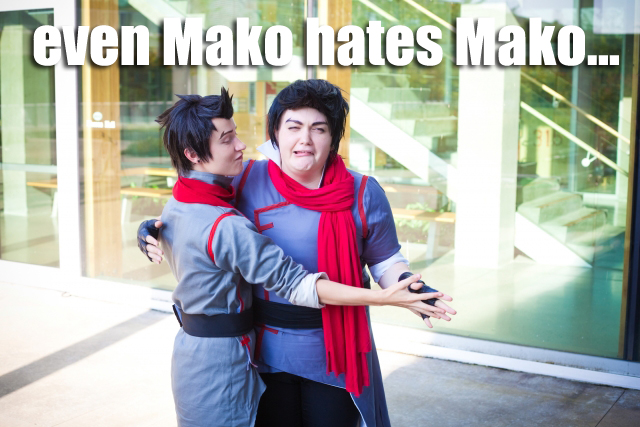
While everyone seems to be excited about OpenMoko, there's a smaller, less proficient group of typers who seems excited about the OpenMako project. Ari Pollack even painted a picture of what that frightening, Mako Hellish, world might look like.
I've always thought it was a little silly that airports use their public announcement systems to give advice on how, and how not, passengers should pack their luggage. Presumably, travelers arrive airports with their bags packed.
Last time I was at Boston's Logan Airport, I noticed that they were repeatedly playing these announcements in the baggage claim.
I think it's interesting that we pronounce some acronyms/initialisms but spell out others -- I've ever reflected on this before.
For example, I think it's funny that we choose not to pronounce the initialism for Uninterruptible Power Supplies the way we pronounce the name of the reason we need them.
I found this box outside my apartment labeled, "The Emperor Clothes." Fortunately, the contents were exactly what I was expecting.
Surely clothing fit for an emperor. That is of course, if you are fit enough to appreciate them.
I found this headline ambiguous:
Negotiators work on Nth Korea deal to close nuclear facilities
When they say "Nth Korea deal" do they mean "North Korea deal" or "Nth Korea Deal" wherein the latter, N is used a variable to emphasize that there have been so many failed deals that enumeration has become difficult.
This is particularly problematic because both interpretations seem entirely appropriate headlines for the story in question.
I've been taking the train frequently lately so decided to sign up for the Amtrak Guest Rewards Program -- kind of like a frequently flyer program but without the flying.
When filling out their online join form, I was asked to select a title from what turned out to be a rather extensive list:
That will be Princess Benjamin Mako Hill to you, Mr. Conductor.
A number of people in the Open Access movement are up in arms because a large publishing group just hired Eric Dezenhall, a man known as "the pit bull of PR," to tackle the "threat" posed by OA.
One might wonder how a nominally talented PR agent would end with such a horrible reputation. Additionally, since Dezenhall hasn't actually done anything for the publishers yet, one might conclude that the act of hiring "the pit bull of PR" might have been a bad PR move in and of itself.
One of my pet peeves is people telling a non-native speaker of a language that they have no accent.
Saying that a person has no accent is like saying that they have no temperature. Annoyingly, people frequently say that also.
The solution to a crypto puzzle I helped solve during the MIT Mystery Hunt was "ALMOST PLAGIARIZE DAN BROWN WORK." Seth Schoen did this beautifully with an extremely humorous parody of Dan Brown's Digital Fortress.
His story, Digital Citadel is extremely funny if you are marginally familiar with Dan Brown and his writing style -- and probably even if you are not.
I have not seen a copy of the prize winning entry in the hunt -- a story called The Ikea Code -- but the excerpt I heard was also hilarious.
Yesterday, I received many requests to post pictures of my rather inaccurate globe. I'm pleased to oblige. Please read the summary I posted yesterday for a list of some of the errors you should have little trouble picking out.
You can click on each cropped thumbnail to see much larger, higher resolution versions of the area and the surrounding continent or region.
Enrico suggested that if the globe was manufactutered in China, Taiwan would be the same color as China and Taipei would be marked as a provincial, rather than national capital. Sure enough, I now have both a good idea of the globe's origin plus an idea of how to spell Taipei with an o.
I gave a talk at a the Boston Ruby group last Wednesday. The meeting was generously hosted by the Boston start-up Back Channel Media. On the way out, BCM offered attendees schwag in the form of branded inflatable globes and Slinkies. On Thursday, I suggested to SJ Klein and Seth Schoen that we might be able to use the globe as a research aid during the MIT Mystery Hunt. That seemed like a good idea until they pointed out that there were a few inaccuracies on the map.
Sure enough, a quick glance revealed that:
Of course, this list is extremely incomplete. I've barely looked at cities, rivers, and even some country names and I've barely looked at the degree to which the cities and labels are correct but incorrectly placed. The full list of errata would, in a manner reminscent of English As She Is Spoke, be very, very, long.
While the globe does not bear any markings of a producer (I wouldn't want to take credit for it either), a group of us suspected that we might be able to find the country of origin by locating the one country that was represented completely accurately.
We couldn't find a single one.
I competed in the MIT Mystery Hunt again this year for Codex (this year, we were Codex Ixtlilxochitl). Codex has improved in the rankings every year. This time, we came in second place solving 106 of 108 puzzles in 40 hours -- only 90 minutes behind Palindrome (this year, they were Dr. Awkward). I'm very much looking forward to helping Codex improve again next year.
Our team has an interesting mix of free software advocates (e.g., myself, Seth Schoen, Don Armstrong, Dave Turner) and a very large contingent from Microsoft. The effect is pretty impressive. I'm looking forward to the days when we work together on much more than just puzzles.
I noticed recently that often had trouble remembering mnemonics. To help remember them, I've started a list of mnemonics that I have trouble remembering on my Wikipedia user page. If there are mnemonics you have trouble remembering, you should leave a comment on my blog or a message on my Wikipedia talk page because it's possible I have trouble with them as well. If I do, I'll add them to my list. If they are not even in Wikipedia's List of mnemonics I can add them so others who forget them also might be able to recall them as well.
One thing I noticed when making the list was that in some situations (e.g., the lists of planets or the hierarchy of the taxonomy in biology), I have no problem remembering the thing that the mnemonics in question are referring to but can't remember the mnemonic itself. Of course, I can sometimes use the referent as a mnemonic for the mnemonic.
Also, since my list is hosted in my user page on Wikipedia, I should also urge you to considering donating to the Wikimedia Foundation to help support the great work they and to insure that they can purchase the bandwidth and servers necessary to keep Wikipedia going.
In his latest talk Lawrence Lessig spends time defending the use of non-commericial use clauses and goes into detail about how the free culture movement does not need and should not have definitions of freedom. In doing so, he was referring to a public discussion the two of us had most recently in September. While my name was not mentioned until the questions, he implicitly criticized both my freedom definition and my call for any definition at all. As usual, his criticism has made me think a lot about what it is that I'm trying to do.
I've been thinking about a conversation I had with Aaron Swartz recently where he was also criticizing me for focusing too much on definitions. He was skeptical about my assertion that social movements and freedom movements needed "definitions." I thought about it and told him then that I thought I'd been making a mistake by saying I want free culture movements to have definitions. More accurately, what I want are goals, standards, or ideals. I want to be able to say, "music when will be free when every producer can do A, B, and C and every listener can do X, Y, and Z." I want the possibility of a shared utopianism.
I want these kinds of goals because I believe that these images of what what things might be like if we win is what motivates us to win in the first place. I believe that the idea that, "things might be better" is simply never as powerful as a strong, perhaps even unattainable, ideal that challenges people and gives them something to strive for. The leaders of other successful social movements I know can tell you exactly what they are trying to achieve -- although few of them ever will realize it completely. No free culture movement leader can do this with any authority. For reasons I've talked about in the past, I think that fact may ultimately make us less successful.
In the free software movement, our most important goal (free software itself) is documented in the Free Software Definition. Even the most ethically motivated among us aren't perfect -- most of us use some proprietary software -- but we have an ideal to hold our behavior up to and a method by which we can always improve. Inspired by free software, I unimaginatively said that I thought free culture needed a "definition." I probably could have found a better way to describe what I wanted and I'll do so in the future. I suppose I should have thought a little more about the definition of definition.
I managed to find the futon we sleep on for $20 (USD) in Harlem. When that mattress got a little compressed and hard, I managed to get my friend Shekhar to loan us his futon and frame for the year. I also found and dragged in a decent fold out bed in New York that we keep in our living room for guests. Last night, I managed to procure a very nice mattress pad for free.
Some might call me the bed winner of the Acetarium household.
I went to buy some pseudoephedrine yesterday because we ran out at home. A sign on the shelf prompted me to ask for it at the pharmacy. They would only sell it to me in small blister-packs and in order to buy any, they wanted to transcribe all of the information on my driver's license.
A little bit of research reveals that this is roughly connected to the national Combat Methamphetamine Epidemic Act of 2005, signed into law earlier this year as part of the PATRIOT act extension. Apparently, pseudoephedrine is used to created (illegal) methamphetamine and meth chemists qualify as terrorists under PATRIOT.
States, however, have gone even further. Oregon has gone so far as to make pseudoephedrine a Schedule III controlled substance that requires a prescription. Many other states, like Massachusetts have made pseudoephedrine a over-the-counter drug that's kept, well, on the other side of the counter. It was, I think, the first I ever had to buy an over-the-counter drug over a counter. Usually, I just pick it off the shelf myself.
I find that fact slightly humorous. But it hardly seems worth collecting and recording a pile of personal information on every person who wants to buy a weeks worth of cold medicine -- particularly when the largest producers of U.S. meth remain outside of the country.
I'm going to be in Seattle between December 16-19 and 26-31 and in Tokyo between December 19-26. I know it's around the holidays but if there are folks in either place that want to meet up for a keysigning or a caffeinated/alcoholic beverage, or even have me give a quick talk at a LUG or something, it might be a lot of fun. Please don't hesitate to get in contact.
I am excited to see that a number of local hackers have organized the first Dev House Boston for this coming Saturday. There are many projects I'm interested in but I might try to take the opportunity to work on my iRony Rockbox Installer because it's likely that there will be many people there with different types of iPods.
If you're going, I look forward to seeing you there, although I might not show up until a little later in the afternoon.
I recently found out that Simon and Schuster (and some other publishers) have been publishing books under an MTV imprint. In a way that is slightly reminiscent of Street Fighter: The Movie: The Game, MTV has given their project the obvious name: MTV Books. That is to say, Music ... Television ... Books.
Of course, MTV Books is hardly constrained to traditional book media and been proactive in releasing MTV Books eBooks (including the intriguingly titled Oh My Goth! and Life as a Poser). Additionally, they have published an MTV Photobooth -- a Music Television photography book.
While they've published Sing Like the Stars! (quite a few of their titles are exclamations), a paperback accompanied by an audio CD, they do not seem to have published an audio book. I am looking forward to the day when they do so and finish the process of coming full circle.
Here's an association or riddle game that Mika and I created last night that I found interesting.
Most people I've talked feel that the problem becomes easier after one realizes that there isn't a correct answer. Of course, the strategy that the second stage invites (thinking of anything without the idea that the answer might be right or wrong) is exactly what the player should have been doing from the beginning. Why don't we? In what situations might we be more creative problem solvers if we pretended that there isn't a correct answer?
Our ice cream was out of the freezer a bit too long and got soft. When I went to extract it from its container, the ease with which I could scoop it led me to spoon out two or three times what I might normally have served myself.
It's interesting to consider that perhaps my thinness is due at least in part to my laziness and frugality in obtaining food.
Overheard on my flight back from San Francisco last week... over the PA system:
Once again, we are keeping our PAs to an absolute minimum on this flight.
Perhaps not an absolute minimum.
With the new Charlie Card coming out, it seemed like it was about time to obtain an RFID blocking wallet. I liked the idea of buying a nice off-the-shelf wallet but the only pre-made RFID-proof wallet I've found is made of leather. I'd like to buy a vegan wallet.
Here is the Venn diagram describing my problem:
If you know a wallet for those of us in the purple zone, leave a comment or let me know. Otherwise, I suppose I'm going to have to make my own.
A banker at my hippy bank had never heard of Google. I had to spell the name out and explain it to her!
I've never imagined one could feel so happy about their choice of financial institution.
Mountain View is quite far from San Francisco International Airport so my shuttle to to UDS-MTV was expensive, but worth it. In any case, I'll be reimbursed for the ride by Mark Shuttleworth.
I wasn't the only one to notice the striking similarly between the abnormal cow born recently in China and the unofficial mascot of one of my favorite free software projects. Thanks for the link Mika!
See for yourself:
True, it's neither a goat nor particularly large, but it seems we can't far away. A very auspicious sign for free software!
Someny noodles, so little time.
If you live in the bay area and you are still willing to talk to me after that pun, please get in contact with me.
While it's been a while since I've been in San Francisco, I've got a flight out Saturday for the Ubuntu Developer Summit in Mountain View. I will have some time — especially next weekend — to hang out.
Once, a friend of mine was cleaning a small tube and asked me to pass him a pipe cleaner.
Immediately and simultaneously, I both realized that I had never questioned the name of my favorite craft supply and understood the answer to the question completely.
Moments like this are like tiny tastes of enlightenment.
Maybe I'm just uncultured but when I first heard the name of the Myopia Hunt Club, my thoughts leaned more toward my vice president than a golf club.
Apparently, I wasn't too far off etymologically.
I went to two talks yesterday about PLoS ONE, an exciting new project by the Public Library of Science. I'm thrilled to see PLoS moving in this direction.
During his talk, Chris Surridge mentioned that the the publishing platform/CMS that PLoS ONE is using is based on Fedora. I mentioned that Fedora, last I checked, wasn't exactly a CMS, a fact that he acknowledged but responded to by saying that I would need to talk to their tech team for details.
Today I found out that neither ideological affinity nor geographic proximity to Red Hat kept the University of Virginia from choosing the wrong name for their Institutional Repository (IR) software. But at least yesterday's confusion is put to rest.
Also, Surridge had a slide with this quote and challenged the audience to come up with the utterer:
The most valuable commodity I know of is information.
I did a quick "I'm feeling lucky" search and was thrilled to see that I came up with this page informing me that I, "do not have rights to view the article" containing the answer but that the information could be mine for a cool GBP £13.00 (plus a handling charge of GBP £1.50 and VAT where applicable).
The phrase, it turns out, belongs to Gordon Gekko, a corporate raider character in the 1987 film Wall Street.
Finally, and least importantly, I object to this image:
Yesterday was Columbus Day. It is a national holiday but is less consistently celebrated, for a variety of reasons, than any other state holiday in the United States. MIT took Columbus Day (and the day after!) off while my class at Harvard went ahead as scheduled.
I saw Luis this weekend but he had to run off on Sunday because Columbia University, of all places, apparently does not celebrate Columbus day.
On Wednesday, I walked into a tree branch. In what is apparently not an unusual turn of events, I ended up with a corneal abrasion (i.e., a laceration on my eyeball). It has hurt my ability to do work because it hurts intensely when I try to, well, look at things.
My friend asked me what kind of tree it was. Interestingly, while my eyes (or my right eye at the very least) was open when I ran into the tree, I don't recall getting a good look at it.
Could Debian developer and Catalan free software translator Jordi Mallach be living a secret life as champion Russian figure-skater Evgeny Plushenko?
Recent photographic evidence uncovered by Mika seems to support such a theory. Decide for yourself:
Several days ago, I got a message from David G. Reichert, my representative in the U.S. House of Representatives (and the incumbent candidate in one of the New York Time's "Races to Watch"). His letter started out:
As your Representative in Congress, I want to share with you some of the work I have been doing to assist orphans in underdeveloped countries.
I grew up in a family that adopted several orphans from underdeveloped countries so I'm glad to see this happening -- I really am.
But what really makes me happy is that I get to hear from my elected representative unsolicited -- for the first time, no less -- advertising his work on such a controversial subject. He seems perfectly willing to stand up for what he believes in, even if it means that he loses the crucial anti-developing-nation-orphan vote.
Who would design consumer electronic products around technological necessity when they could design them around clever bits of word play?
I came up with the idea for an "iPod Tripod" -- if you will, a "TriPod" -- and was thrilled to see that someone else had already (a) stumbled upon the same little rhyme and (b) followed through on the idea and was already selling a product!
The review I read seemed to indicate that the execution was not quite as good as the name. But then again, how could it be?
It's worth nothing that many people seem to have a hard time spelling, "it's worth noting."
I bought a TV-B-Gone a few years back. It's been fun. I make a point of never turning off a TV that anyone is obviously watching and have only once had anyone turn a television back on. Most people find it easier to just talk to the person sitting across the table than to turn the TV back on.
The only problem is that I can never really tell in advance when I'll need my TV-B-Gone and so frequently end somewhere wishing I had one when I've left it at home. What I really need is a TV-B-Gone-B-Here.
In my mailbox today (links are added):
Dear Boston Vegetarian Society List,
The curator of the World Carrot Museum will be joining us at Happy Buddha on a visit from the UK!
I've never met anyone who has created a museum about a vegetable but I'm intrigued. I'm also pleased to see that similar ventures exist for vegetables that I enjoy even more than carrots.
During Wikimania, I was explaining to someone that Aziz Ridouan (Audionautes) was staying at Elizabeth Stark's apartment, that Elizabeth Stark was staying at Jean-Baptiste Soufron's apartment, and that Jean-Baptiste Soufron was staying at my apartment.
In fact, all four of us have slept at least one night at both the Acetarium and at Jean-Baptiste's apartment in the last month and a half.
What do you a call someone who studies meteors?
No, really.
I feel like people should not give software for physicians names that are a one letter substitution away from "malpractice".
Namie Amuro is a very famous Japanese pop star. Mika pointed me to her most recent album. The title is, Can't Eat, Can't Sleep, I'm Sick.
I like the title! While Namie goes into some detail on the nature of her malady in the title of her piece, I think it would be even better if she did so more.
Like, for example, in my new upcoming single, Can't Think Straight, Can't Stop Vomiting, I'm Sick.
My friend Seth recently pointed out that the Brazilian Real coins look strikingly similar to the Euro coins.
I agree. This was something that I noticed on my last trip to Brazil as well. In fact, they are so similar I had trouble telling which one were the knockoffs or which were Real!
Mika and I applied for membership at the Boston Athenæum today.
In addition to paying the USD $160 yearly fee, were each asked to provide three references who can attest to care for books. That's right; three references to get a library card. This is a very good library. We'll hopefully hear back about our application within two weeks. If we are accepted, we'll be able to take guests into the library with us.
The Athenæum has, among other things, a copy of Narrative of the life of James Allen, alias George Walton, alias Jonas Pierce, alias James H. York, alias Burley Grove, the highwayman. Being his death-bed confession, to the warden of the Massachusetts state prison. It is bound in the authors skin.
Apparently, while rare, this is not entirely uncommon. The Harvard Law Library has another example of anthropodermic bibliopegy and just a couple months ago, someone found a book bound in human skin in the middle of the street in Leeds.
It's about time for a wrap-up on the recent major event in my life.
On May 29th, Mika Matsuzaki and I were married.
The festivities kicked off with a parade through Somerville's Davis Square. Andres Salomon kept rhythm on drums and, thanks to my new lab adviser Chris Csikszentmihályi, we had a couple dozen other wikipedians, hackers, technologists, and biologists keeping tune on kazoos. Like all good Somerville parades, we forgot our parade permit. Which was fine.
On the marginally more traditional side, we exchanged vows (written under a mathematical constraint -- Mika's idea) and rings. The marriage was made official by Oxford/Harvard professor of "Cyberlaw" -- who I once worked as teachers' assistant for many years ago -- and Massachusetts Justice of the Peace, Jonathan Zittrain.
We ended the day watching the sunset with the serious party-goers from out of town, Debian, and the FSF. Then off to dinner and "happily ever after."
Lots more pictures are linked the Cambridge wedding page on our wedding wiki. If you have pictures, you should link them there or mail them to use and we'll upload them. If you want to send messages of congratulations, please visit that page for mailing instructions (best!) or a wiki page to write them up on.
Just yesterday, we received (via Joey Hess) four wonderful pages of tightly packed congratulations messages from the attendees at DebConf. Although it's not a constitutional matter, I'm pretty confident we had more than 3Q developers signing that form which, in a Debian election methods sort of way, really warms my heart. Thank you everyone! It's really too bad we missed DebConf but we're both determined to make next year!
Bookmarks are one of the simplest things in the world. If I want to mark my place in a book, I can almost always find some random scrap or object which, immediately at hand, is able to serve the purpose.
I was reflecting today on the fact that there are people who make their living making or selling bookmarks. Its true! They make their living selling bookmarks.
There is hope for me yet.
Here's an addition to my personal list of villains.
Imagine someone who intentionally leaves their mobile phone on -- perhaps even on an extra loud "outdoor mode" and with an particularly obnoxious ringtone -- during movies, symphonies, plays, or lectures. While this person isn't so nasty that they would plan or prompt a call, they enjoy the thrill of knowing, at any moment (but especially during the quiet or emotionally charged parts of the performance), that it could all be ruined. And that it would be their fault. Of course, they would act embarrassed and brush it off as an honest mistake.
In my infinite spare time, I think it would be fun to make a parody of an MTV style "documentary" about one day in the life a person with a Hitler mustache to show ridiculous that genre has become.
The video will be done with 15 second cuts and and with a bumping soundtrack by an eclectic selection of artists from the full spectrum of popular music. It will follow around a person for one day as they have a barber chisel out a Hitler mustache and then spend one day in that form. These scenes will, of course, be interspersed up with snippets from interviews with vapid onlookers, fashion gurus, and celebrities weighing in on all sides of the many "issues" that wearing a Hitler mustache raises. These issues might include:
If you would like to donate resources or time to this project, please let me know.
Today I heard someone say, "apparently, it's not visible.
Clearly, a confused statement.
Something about this museum in Eindhoven made my think of my friend Daf.
I bet Wikipedian SJ Klein one dove that pigeons and doves were one -- one and the same that is.
Wikipedia says, "the terms dove and pigeon are used interchangeably." Of course, this picture of a Chequered Rock Dove is what really seals the deal:
As you can guess, Rock Doves are commonly found in city parks and widely known as "feral pigeons."
Because I won, SJ can pay off the debt with a pigeon.
Believe it or not, there is news that is even cooler than the free content and expression definition. The news is that after knowing each other and dating for something like 7 or 8 years -- on and off but mostly on -- Mika and I are going to be getting married. Here's a picture of the two of us at a picnic last weekend:
If you read my blog, you've probably seen my frequent links to hers. If you hung out with me in Seattle, Boston, or New York, in the last 3 years or have ever visited The Acetarium, you probably already know her.
We've told our families and many of close friends and will going ahead with a wedding and parties in the coming months. At the very least, we'll be having parties in Cambridge (Massachusetts) and in Seattle. Neither of us are particularly traditional and I don't imagine we'll make a very traditional married couple. But we are crazy about each other and in it for the long haul. And that's what counts.
The only bad news it that it means that I won't be making Debconf this year -- for the first time in four years. With a little bit of luck I'll be back (perhaps with Mika who attended Debconf 4) next year.
If you want to send messages of congratulations. You could make us really happy by sending them in the form of cards or postcards. You can mail those to:
Benjamin Mako Hill and Mika MatsuzakiThe Acetarium1010 Massachusetts Ave, Apt 54Cambridge, MA 02138USA
Stay tuned for information on forthcoming parties and celebrations.
Mika and I are hosting a guest visiting who has decided to do many of the normal tourist things while in Boston. Yesterday he went on the freedom trail and saw Old Ironsides.
Old Ironsides is, of course, the USS Constitution and it is the oldest commissioned ship in the US Navy. Constructed from 2,000 oak trees (!) it is one of the few ships in the US Navy whose sides are not made of iron. In this sense, Old Ironsides is a bit of misnomer. Admittedly, the nickname is catchier than the more accurate Old Sides.
Can graphical representations of asexual reproduction accurately be called "micro-organism porn?"
Binary Fission: Porn or Not? |
Mitosis: Porn or Not? |
Yesterday was St. Patrick's day. I saw a group of WASP Harvard College students wearing green St. Patrick's Day sombreros.
In the words of Joe Wenderoth, "This Freak Show is too long."
We often hear about the technical advances that occur at Debconfs. For example, using only Debconf signage, I once invented a portable toilet that was the size of a single sheet of A4 paper.
The picture is a bit blurred but you can get the idea:
I haven't blogged recently and have been somewhat quiet and out of touch over the last few weeks more generally. I've certainly been busy but have also been trying to find words to describe the recent death of my friend and colleague, Push Singh.
Push was a next-door neighbor at the Media Lab, an academic neighbor in the Electronic Publishing research group, and a neighbor in my building at home. If you've come to parties at the Acetarium, chances are you met him. Push was an up-and-coming AI researcher and something of a protege of Marvin Minsky. He had recently accepted an appointment to the MIT Faculty starting next year. His loss has come as quite a shock to everyone, to say the very least.
Last Thursday was the last of several organized memorial services for Push and it now seems that its time for those of us effected by his death to get back to our lives.
Rather than poorly summarizing Push and his impact on me here, I can point you some of the things that I and others said about him on a wiki page we have created to collect remembrances and in the obituary published in MIT Tech Talk.
Push will be missed and I will continue to mourn his loss.
I saw an advertisement for PubCon today. It merely listed their name and their slogan/motto/catchphrase: "We start where other conferences finish."
I thought about that for a second until I figured it out. Where do other conferences finish? Obviously, they finish at the pub! Hell, any decent conference will they finish in the pub not just once but every night. What a great idea! Why not just avoid the whole conference bit altogether and just go to the pub in big groups of like-minded people!
It turns out, it's just some gathering for anyone "involved in the production, marketing, or management of a internet web site."
Very disappointing. I will not go. You shouldn't either.
If I remember and have time when PubCon is Boston (unlikely, remind me if you like the idea) -- April 18-20, 2006 -- I will try to organize my own PubCon, which will actually start where other conferences (including PubCon it turns out) finish.
I don't think I ever blogged about the time I saw an ambulance being jump-started by another ambulance.
I laughed at the time but the situation made me very uneasy. Nobody wants to see something they depend upon in crucial moments in such a pathetic state. In the future, I think they should do these sort of jump-starts indoors.
Of course, it did answer one question. An ambulance's ambulance is, it turns out, just another ambulance.
I just created a stub in Wikipedia for the Hydrodaktulopsychicharmonica. I will visit the Music Library today for more information on this wonderfuly named instrument. If you have more information already, please contribute to the page.
I've been spending what is increasingly clearly too much time reading the news lately and think it might have a negative impact on my intelligence.
Here's one example of why I think this, taken from local news:
A teenager accused of going on a rampage at a gay bar with a hatchet and a gun sometimes glorified Nazism and had a swastika tattoo but never previously expressed any prejudice toward gays, friends say.
I'm sure he was the tolerant, sensitive, pro-gay-rights, secure-in-his-own sexuality kind of Nazi. Thanks Forbes for filling us in. Even if his friends are in fact ignorant enough to believe this, I'm don't see how this is newsworthy.
Here's another bit from international news
The United States is expelling a Venezuelan diplomat after the Caracas government Thursday ordered an American naval attaché to depart for alleged spying.
...
State Department Spokesman Sean McCormack did not accuse Figueredo of any wrongdoing and did not explain why she was designated for expulsion other than to say she was the "most appropriate" choice.
McCormack said the United States does not like to engage in what he termed "tit-for-tat diplomatic games," but said that Venezuela initiated the action and U.S. officials were forced to respond.
Copyrighteous spokesman Benjamin Mako Hill reminds McCormack of the definition of "tit-for-tat diplomatic games."
My friend Radu uses memoryaid as his IM name. I added his nick to Bitlbee several days ago but had to take advantage of Bitlbee's "rename" functionality to do a little rename memoryaid radu. I couldn't remember that Radu was the person behind that nick.
alias psudo=fakeroot
<@biella> I can't speak for biella, but...
Oh, I think you can.
And now, for a visual pun about the king of fruits:

I have no desire to be famous.
Of course, I wouldn't mind if people didn't think of (a rather lecherous) someone else when they heard my name.
Someone suggested that I was a perfectionist yesterday. The truth is very much the opposite. I'm an imperfectionist.
If you use dict to look up the word "cobbler" with a "standard" set of dictionaries installed, you'll get a GCIDE definition and the following Wordnet definition:
cobbler (n)
- a person who makes or repairs shoes [syn: {shoemaker}]
- tall sweetened iced drink of wine or liquor with fruit
- made of fruit with rich biscuit dough usually only on top of the fruit [syn: {deep-dish pie}]
Normally, if you misspell a word or try to look up the plural form of a noun, dict will suggest the correct word. However, if you look up "cobblers" you get:
cobblers (n)
- nonsense; "I think that is a load of cobblers"
- a man's testicles (from Cockney rhyming slang: cobbler's awl rhymes with ball)
It's not clear to me whether this was non-graceful failure or even failure at all. It is clear that it was not what I was looking for. An educational experience nonetheless.
A few days ago, I compared Mika (unfavorably) to a Decepticon. Not having played with transformers as a child and having grown up in Japan where, evidently, they are called "Destrons" instead, she missed the reference. She asked if they were anything like Leprechauns.
As it turns out, they're not.
In about a week, the MIT police department is going to install proximity-card locks in the building. I am worried about the fact that the MIT card office stores data about card use for 14 days but am optimistic about seeing this issue addressed.
However, I suspect that the MIT police department has an ulterior motive in installing this new system. Currently, if somebody is locked out of the building, he or she can call the MIT police to be let in. Of course, the individual must first show their MIT ID card to the police. In the new system, where the MIT ID is the key, it seems like there will be very few situations where the police need to follow-up on lockouts.
As a work-reduction measure for the police, it seems quite clever.
In this article, Xinhua's headline tells us, "Likely cause of space shuttle trouble found: NASA."
While I'm sure this statement is true, I think that swapping the text on the sides of the colon would be closer to their intent by locating the source of the information -- and not the source of the problem -- with the agency. NASA, after all, is a pretty tricky problem.
I was sad to see that the local Cinderella's Pizza is open (and delivers!) past midnight. They do not serve pumpkin pizza (or any other pumpkin dishes) at any time of the night.
If I were in charge, things would be different.
Because there are people that seem to be unclear on the subject:
The reason people type "l10n" and "i18n" instead of "localization" and "internationalization" is because the words' length makes them difficult to type. Tech communities are willing to put up with this ungainly and opaque shorthand for the sake of our wrists.
In spoken English, "EYE-eighteen-EN" is not easier to say that the expanded form. Pronouncing the keyboard shorthand does not imply that speaker is savvy or in the know. It should not be done.
Mika and I were discussing logistics for our upcoming party and wondering where we would put people if the crowd got too big.
I said something along the lines of, "well if push comes to shove, we can always stick people in the back room." Clearly misunderstanding, Mika's face showed a mixture of confusion and disgust.
We were only able to continue after I made it clear that I my intention was not to isolate and quarantine my friend, Media Lab colleague, and neighbor, Push Singh in our bedroom.
This coming Friday, The Acetarium will host a party to celebrate the beginning of my twenty-fifth year of life.
According to the CDC's live expectancy data for people of my sex, age, and racial demographic, I am projected to live 51.0 years past this coming Friday. In three months, perhaps I should throw a "1/3 of my projected lifespan party."
Details are on The Acetarium website. If you're in Boston and would like to come, please let me know.
Buy Nothing Day is upon us again. As usual, it's being held in the US on Black Friday and elsewhere either on Friday or the day after.
I'm a supporter of BND and try to celebrate each year. Unfortunately, it usually ends up turning into, "buy everything you would buy today the day before day." This arrangement is certainly more convenient for those who like to eat but perhaps not entirely in the spirit of things.
Access and borrowing privileges at Harvard libraries is one perk of being an MIT graduate student. Actually taking advantage of the privileges of course is a borderline Kafka-esque quest that involves 5 forms, several databases, two universities, a rather impressive MIT libraries official stamp, and three geographically separated offices on opposite ends of Cambridge. Only once all those obstacles are triumphantly overcome can one go through the two card swipes and/or manual verifications necessary to get into the Widener stacks.
The webpage makes it sound easy and, in all fairness, nothing about the process is threatening or difficult. While the libraries are worth the effort, it is long and tortuous: by no means for the bureaucratically faint of heart.
The high point of the process, in my opinion, is picking up one's ID from the Harvard ID office. The ID office is appropriately located on the ninth floor of a building that requires ID to enter.
In my computer supported collaborative work seminar, we were discussing the design of table-top systems for synchronous collocated collaboration. There was a bit of conversation on the problems and strategies with images projected onto the table (e.g., people getting in the way of the beam). There seemed to be consensus that most simple and effective solution was projectors mounted directly above the table.
I pointed out that, in this context, straight down was the most straightforward.
I think "Cilia" is a pretty name for a girl. My biologist friends disagree. As far as I'm concerned, it sure beats Flagella.
Kiko, Micah, and I ate at Legal Seafood's yesterday and had this little message on the bottom of our bill:
PLANNING A REHERSAL DINNER? MAKE YOUR ONCE-IN-A-LIFETIME EXPERIENCE UNIQUE. JOIN US.
Where I come from, rehearsals are things are things that, by definition, happen more than once. When they do happen, it's usually with an a between the e and r.
Of course, I have to respect Legal for so succinctly combining a redundancy and a contradiction on the same topic.
Last night I was out in Dublin and, due to the length that the night dragged on, I invited my friend to crash in the extra bed in my Hotel room in central Dublin rather than return to his place in the suburbs which, at that point, may well have been impossible.
When someone came by to clean the room in the morning, they noticed both beds full and reported this to the Hotel managment who called me up to say that they knew the room had been "double occupancy" last night and that they wanted to know if it would "single occupancy" the next night.
That's a pretty strange way to talk if you think about it. There is an extra person in my room and the Hotel complains that my room has somehow changed into a new state that they are unhappy with.
I suppose this circuitous way of speaking is designed to avoid any potentially embarrassing discussion about who the extra body is and why they are there. That said, this type of obtuse conversation is difficult for patrons to puzzle through immediately after being awoken.
Dublin, of course, is great.
If one is in a public or shared restroom at a urinal or in a stall and the person at the adjacent urinal or in the adjacent stall sneezes, is it appropriate to say "bless you" or "gesundheit" or another culturally appropriate post-sneeze statement? Is it appropriate to say nothing at all?
It's cold season at the lab and the fact that I do not know the answers to these questions is becoming a source of stress.
Obelisks have been on my mind recently.
I think it started with this suggestion I made to help use up some space in the newly remodeled "Alley" (the new home of the Electronic Publishing Group at the Media Lab):
I think we would be wise to purchase and display this very high quality seven foot Large Reprocessed Garden Obelisk in the Alley.
In addition to the happiness that the presence of its simple geometric shapes would bring us, it would provide us with both a great conversation starter and an undeniable symbol of our power during Media Lab teas.
Good morning Freud.
There was some confusion about my recent post on the Melnick book on manhole covers from people who were unfamiliar with the term "manhole." One way to describe a manhole cover is a sewer lid. However, manhole covers are employed to cover a variety of holes that men (and women) explore for a variety of purposes. I prefer to think of a manhole cover as exactly what an obelisk isn't.
My country's national intelligence is now in the hands of a man so powerful that he is not publicly referred to with even a fake last name.
Of course, it's nice to know that as mysterious as he is, "Jose" is a maximum of three shorts degrees of separation from me on the social networking graph. Add this to the list of benefits that come from knowing Nicholas.
One benefit of having a blog is that you don't have tell the same stories over and over to all of your friends and acquaintances.
One drawback is that you can't.
I have a sore throat today and I asked Mika if she had any Fisherman's Friends. She asked what they were. I said "fish."
I was making a joke. After all, calling a fish a "fisherman's friend" implies a relationship that is beyond the realm of even dysfunctional friendships. Of course, this also makes one wonder about the term "friend" in the context of a throat lozenge that hardly fairs any better than the fish in the same company.
I was talking to Eben Moglen a couple days ago. In addition to saying many insightful and inspirational things, Eben used the word "physical" metaphorically.
I am looking for suggestions on sensible way to use the word "metaphor" metaphorically.
While some people think it's fine to soak their contacts in water overnight, it is my opinion than water is no solution.
In a paper on computer supported collaborative work I was reading recently, I read this line in the opening paragraph:
This has partly to do with the fact that in recent years the importance of understanding human computer interact ions in social and cultural context has increasingly been acknowledged.
I spent longer than I should have trying to figure out what "interact ions" were before I realized that there had simply been an extra space inserted into "interactions."
I still think "interact ions" sounds like an excellent Media Lab project.
At the lab, I share an office with two folks working in Push Singh and Marvin Minsky's Common Sense Computing artificial intelligence research group. The group has recently been looking at finding new corpora of data for helping to teach computers common sense. Recently, someone had the idea of using blogs as a source. My officemate, Dustin, decided to try out Livejournal.
Now LJ has something of a reputation for being a place where angst-ridden and depressed teenagers vent their spleen. From a small random sampling of data, Dustin seems ready to conclude that:
These snippets are from the first 5-6 random posts:
Certain people think I suck, but others don't. Feel free to be the judge.
...
And I'm going to slaughter the person who gave me whatever it is that I have right now. As soon as I find them. And I'm about to be one of those people who go to work sick because I need money.
...
My thoughts of late have been pretty scattered and off the wall. But the last few nights have been very rough on me. My dreams, actually nightmares, have been of death, violent death. Death of myself, both body and soul. As a result, I am in the process of making a will. I don't want to sound morbid but I feel that this is something I have to do. I'm not sure why and maybe I'm just in a wonky mood.
The Hitch Hikers' Guide to the Galaxy anyone?
It seems that the new exclusive Cambridge, Massachusetts social space The Acetarium is having it's grand opening at the same time and in the same place that I'm having my house warming party.
Both parties are tomorrow (Saturday September 17th) at The Acetarium.
If you're interested in coming to either event, contact me. The time to show up is 8pm or later if you're interested in just drinks and earlier (4pm on) if you're interested in making or eating sushi.
The MTA runs the subway, buses, and some commuter rail lines in New York City. It runs 24 hours a day and every day of the year. I can say without hesitation that is the best public transportation system I have ever used.
In addition to all of those things, the MTA also runs a beta version of a Weekend Service Advisory notification service. Because the subway does not close at night, most maintenance work is done on weekends and there are always strange service changes or interruptions (e.g., subways may run only local or express, be replaced by buses, etc). Normally, you find out about these by reading the signs posted in the stations.
The MTA Weekend Advisory System aims to put an email interface on all of this. You can log in with an email address and select the train lines that you want to know about and then changes made to those routes are emailed to you every Friday. From a technical perspective it sounds pretty simple.
If you visit the advisory site you will see uninterpolated VBScript at the top. You will soon understand how absolutely appropriate this is.
After the two weeks where the site didn't allow me to sign up, I got my first email. It began something like this:
Dear NYC Transit E-mail subscriber:<?xml:namespace prefix = o ns = "urn:schemas-microsoft-com:office:office" />
It's basically it's been that way every since. Every week I get an email full of what looks like Microsoft specific uninterpolated XML variables. I've been wondering for months how they can send these out week after week and not notice that they are completely unreadable.
I think I've discovered why. The advisories use a multipart/alternatives mail and the HTML looks file. The reason that I (and everyone else I know) has been seeing the garbage is because we all read text/plain if it's available and the brokenness is hidden if you read the HTML. Apparently, the MTA developers have not ever read their own text/plain advisory.
I would unsubscribe from the advisories now that I have moved away from New York except that:
Thanks to Andres, Ari, and Alana, I'm mostly moved into the Acetarium. People's who name did not start with "A" were also invited to help but, for a number of reasons, universally failed to do so. Mika, Micah and myself (Mako) helped load the truck in New York. Andres also helped in New York. This was unfortunate for the purposes of alliteration but was appreciated in general.
So far, it is treating me quite well. Mika arrives tonight.
There are three things that relate to my home that I think I should mention.
First
Some people have asked me about the name of The Acetarium. In Latin, acetarium means salad. Clint has was taken back and asked if I lived in a salad. Of course, this would be ridiculous. I don't live in a salad. I live in the salad.
Second
It turns out that I was incorrect in my previous post. The building that I live in does have a name and that name does include a definite article. This is above the building's threshold:
In fact, the full name of my apartment is:
The Acetarium at the Cantabrigia
The presence of two definite article makes me happier than many might imagine.
Third
If you live in Boston, there are a couple upcoming events at The Acetarium you might be interested in. The first is a Grand Opening (i.e, house warming) which will be on the evening of Saturday the 17th. Mika and I will be making sushi so if you want to help or learn, you should show up early. This is an open invitation and I would love to meet new people in the area but please call ahead and please make sure I know you are coming.
We're also planning a party for folks displaced from Seattle. Perhaps with geoduck on the menu and certainly with other Pacific Northwest drinks and dishes. If you have live in Boston and miss Seattle, you should come.
Please watch the website or the rss feed for information on these and other events.
|
I recently transported Betta-Max from New York to Boston. He rode in the cup-holder: In both his permanent and temporary homes, he has a little fake plant in his tank. People claim that the plant is designed to make the tank feel more like the fish's natural environment and to put the animal at ease. I believe that in most cases, the fake plant is not for the fish at all, but for its owner. |
![]() |
At college, I was a frequent users of the college library's Inter-Library Loan (ILL). In the last few years, I have missed the feature sorely.
At last, I have returned to the academy. My license to ILL has been restored. It feels good.
I've mentioned before that I've always been interested in the way that fancy buildings have definite articles in their names. They also frequently have websites and fancy Latin names. I've never been able to live in such a building.
Until now.
So while the one bedroom apartment in Harvard Square, Cambridge that I'll be sharing with Mika, Cambridge not be too fancy. We're going to make sure that it sounds fancy. Without further ado, I give you:
The Acetarium
The website is complete with an rss feed of upcoming events and parties at the house and a strong recommendation from Paris Hilton.
I'm going to be carrying our couch and some boxes into the house this Saturday around midday and will have a crate of Corona for the occasion. If you are in Boston and you want to help out by riding an elevator for half an hour and enjoying a whole load of beer, please contact me about the timing. We'll have a good time.
Well, I'm in Boston now.
I called up NSTAR, the local gas and electricity provider, to have them schedule to transfer the utilities into my name so that they are not turned off when the previous tenant moves out.
The person on the phone asked, "do you want to transfer both the electricity and the gas into your name." While the idea responding with a no is mildly amusing, I'm not entirely sure that the question needed to be asked.
Although many people suggested that it was impossible, I am forced to admit that one of my greatest fears has come to pass. That's right, I am no longer the person in my apartment with the largest sunglasses.

My only consolation is that I remain, thanks to the generosity of Marcell Mars, the person with the longest-billed hat.
Last weekend, I attempted to fix an ailing member of my stable of IBM Model M keyboards after wearing out a buckling spring. I do this frequently enough that I have purchased both extra springs and a special tool for opening and closing the keyboard.
However, while popping heat rivets off the bottom of the keyboard, my hand slipped and I managed to lacerate the top of my right index finger's knuckle against the side of the steel backplate. It was a nasty cut. While I didn't get stitches, I probably should have.
Seth pointed out that this was a second order typing injury.
Since Sunday, my finger has been wrapped tightly in gauze and my finger has been in a series of homemade splints to keep the knuckle from bending under the cut. Typing without my right index finger is awkward and is straining my hand and causing soreness.
Seth suggested that this was a third order typing injury.
I'm less sure. It sounds a bit like a first order typing injury instigated by a second order injury. Perhaps though, this is just the natural process of typing injuries coming full circle.
It's an old adage that "lightning never strikes twice." It's becoming increasingly clear to me with time that this is bullshit.
Last week, the switch in my building (and everything plugged into it) was struck by lightning for the second time this year. Last time my whole computer needed to be replaced. This time, it was only the on-board Ethernet that seems to be fried. It means that my workstation is a much less effective router now but it beats buying a new computer.
Wikipedia has this to say about the whole thing:
The saying "lightning never strikes twice in the same place" is frequently disproven. The Empire State Building is struck by lightning on average 25 times each year, and was once struck 15 times in 15 minutes.
The Wikipedia page authors' were also quick to dispel another hypothesis that, I'll admit, had crossed my mind:
Some repeat lightning strike victims claim that lightning can choose its target, although this theory is entirely disregarded by the scientific community.
My IRC nick-highlighting is such so that today, all messages directed toward a new person named imako on #ubuntu triggered my attention. While this is easy to fix, it made me consider how frustrating IRC with nick-highlighting must be if you have a nick that is also a common word in a language you communicate in.
I spent a few moments on Freenode today with nicks including the, and, is, it, to, an, as and a.
I was surprised that everyone of those nicks was registered with the nick server. I was not surprised that all were available at the time I tried and that all but the and and had been untouched for the better part of the year.
Let's face it, if your nick was it, you wouldn't enjoy IRC very much either.
There are at least two things funny about this (non-staged) desktop screenshot that a friend took a year or so ago:
The background image is a picture of myself and my brother Nate. We were cold and less than completely comfortable and trying to convey this feeling through body language.
The first funny thing is the degree to which my friend has embraced the Windows folder naming conventions as illustrated by this closeup:
I'll let you all speculate about what the funny things might be on your own.
Greg Pomerantz recently purchased a light bulb called a "black body bulb." When he told me this, I misheard him and thought he said he had purchased a "black hole bulb."
A small electrically-powered black hole that could be installed into a lamp is not only more technically challenging than building a light bulb. It is also, when you think about it, exactly what a light bulb isn't.
Many people have probably followed the plight of the Russian sailors stranded 190 meters under water in a mini-sub. It was nice to see militaries around the world put aside their differences and come to the mariners' aid.
But it's worth pointing out this article lest anyone believe that the air of camaraderie in crises diminished the sense of machismo, competition, and old fashion "mine is bigger than yours" boosterism that is so central to our militaries. I quote:
Britain, responding to a request from the Russians, was sending a Scorpio remote-controlled underwater vehicle capable of descending 925 meters.
A U.S. Navy spokesman said a Super Scorpio, an unmanned deep diving submarine capable of reaching a depth of 1,515 meters, would be airlifted to the scene from San Diego naval base in California.
I'm glad to see that nobody was distracted from singing the praises of their expensive toys' 900 meter plus diving capabilities by the fact that the stranded mini-sub in question was only 190 meters below the surface. It's a shame that the British did not have time to arrange for an "Ultra-Scorpio." Something like that could have really saved the day.
After a 3-4 month break, I was catching up on mail in the Unicode email list and I noticed a number of threads about the interrobang (my favorite punctuation point and perhaps my favorite Unicode code point (U+203D)).
At Debconf5, I was talking with a number of the Spanish speaking developers about the lack of an inverted interrobang in Unicode which renders the glyph less useful in Spanish which normally prefixes questions or exclamations with inverted versions of the glyph at the end of the sentence. Why shouldn't this carry over the interrobang as well‽ I was, quite seriously, thinking about writing up a proposal for the inclusion of an inverted interrobang myself when I found this message from Michael Everson on the Unicode email list:
N2935: Proposal to add INVERTED INTERROBANG to the UCS http://www.evertype.com/standards/iso10646/pdf/n2935-interrobang.pdf
This will be posted to the WG2 and L2 sites in due course.
After composing a message to Michael thanking him for his proposal, I realized (helped by the announcement to withdraw the entire Unicode Standard immediately after Michael's proposal) that the proposal has been sent on April 1st and was, in all likelihood, a joke. How cruel is it to toy with my emotions like this‽
Sent about a month later, I found another message from Michael saying:
I suppose I should note that despite the date of its publication I am completely serious about: http://www.dkuug.dk/jtc1/sc2/wg2/docs/n2935.pdf
I have written Michael to confirm that he is serious. In any situation, I think it is important that all supporters of the interrobang (and it's inverted cousin) make their voice heard in Unicode to ensure that the inverted interrobang gains a much-deserved spot of its own in the standard.
Update: Michael Everson has told me that the Unicode Technical Committee has asked him to first find Hispanic support for an inverted interrobang. If someone knows of this or of a list for Spanish typographers where we can ask, please let me know.
Over the last few months, it's been disconcerting to see the reported cases of people getting fined (or worse) for using open wireless access points without permission.
I travel frequently and the use of open APs is an important (if not always reliable) way that I get online. Every time my Internet connection at home goes down, I take advantage of one my neighbors APs. To balance things out, I make sure I always run an open AP for others out my home.
There are many smart reasons not to run an open AP but, for me, doing so is about being a good neighbor. I've found that even for the most cautious and conservative, most of the serious risks of running an AP can be mitigated by a measured combination of firewalling and monitoring.
The most ridiculous part of this crackdown is not how common and completely normal intentional "transgressive" wireless sharing is but how how often people do it completely unintentionally and without ever knowing.
Once I was in New York City with Micah and Biella and, knowing that we were technically proficient, a member of Biella's extended family invited us over to help fix his printer which he was unable to print to over his wireless network. What eventually became clear was that his wireless AP was set of incorrectly and had never worked. His laptop couldn't find the printer because the printer was on his home network and he had, without his knowledge, been using his neighbor's wireless since he moved in. He had been paying for DSL which he had never actually used.
In densely populated places -- New York in particular but any Western city probably falls into this category -- this is incredibly common. Punishing people for doing what so many people do completely unintentionally -- and almost entirely without negative consequences I might add -- would be silly if what was at stake was not so serious.
What the Hack starts in a couple days and I'm already in the area. It promises to be a fantastic outdoor hacker summer camp.
Howver, I'm a little worried about one thing. It's raining now. A lot. It's basically rained every day in the last week. I feel like that many people, that much electrical power, and that much water is a bad combination.
My plan is to stick with with my friend Andreea. That way if the worst happens, at least we'll be putting the cute in electrocute.
I've been somewhat disappointed with the lack of community participation in some of what I feel were my most fun and potentially contagious blog entries. For example, after spending almost two hours forming a list of packages useful in writing package name poetry, not a single person added to the body of work in the genre.
I think the problem may be lack of incentive and I've stepped up to remedy that. I have purchased 10 Dutch Bottle Scrapers (also known as flessenlikkers or flessenschrapers in the Netherlands) and I will be giving them away as prizes for small competitions I coordinate on my blog in the near future. While they are not expensive in the Netherlands, for the rest of world, these wonderful kitchen tools are absolutely priceless.
To learn more about flessenlikkers, read the Wikipedia article I wrote on the subject. While they may not look like much, I've been walking around with 10 flessenlikkers in my backpack over the few days and I often feel that I've found the true source of ultimate power.
A couple weeks ago, I realized that one of my eyebrow hairs was long. Like really long. Like 3cm plus. Other hairs were long too. What's weird is that as far as I can tell this is the first time I've ever really looked at my eyebrows closely in my entire life.
I'm almost embarrassed to admit this since they are, after all, less than a centimeter from my eyes. Then again, this close proximity both makes it logistically difficult to scope them out and introduces a sense of assumed familiarity.
Then again, perhaps these are just rationalizations and I am just the sort of guy who wouldn't notice a mustache if it were right under my nose.
I come from a pretty diverse family. I have a sister adopted from Korea and two sisters from Ethiopia.
Once I entered a Men Who Cook competition and the winner in the deserts category was someone who had brought a habanero and lime cheesecake. It was very tasty and I've made it several times since then. Since the cheese and the lime both tend to cancel out of the heat, the cake is usually just like a cheesecake that bites back a little bit.
Once though, it was really hot. It was tasty but there was a limit to how much one could eat. Since it wasn't going fast, I suggested that my mother could serve pieces of the cake at her book club meeting. One of my Ethiopian sisters, apparently very worried, warned me, "You have to be careful! That cake could kill a white person."
If you don't mind a little bit of heat, you can try the recipe for Habanero Lime Cheesecake That Can Kill White People yourself. Sorry for the Imperial measurements for those of you outside of the US.
Yesterday I arrived in the Netherlands. Until a few weeks ago, I thought that the Netherlands was home to the most fun looking written language in Europe. The long strings of double vowels in Dutch frequently make me smile.
After last week at Debconf5 in Helsinki, I'm ready to change my mind. Finnish has everything Dutch has and more.
I mentioned to Mika that I would be going out to dinner at a restaurant called Töölönranta. She mentioned that she thought the name was very cute because of all of the "eyes." I suggested that the might in fact be umlauts or separate umlautesque graphemes (as the case seems to be) but she remained confident that they were, in fact, eyes.
Linguistics aside, I think she's right. Finnish wins.
Yesterday, I arrived early to my flight from Amsterdam to Helsinki. In fact, I arrived exactly three hours and one month early.
Apparently, the travel agent has booked me on flights on August 10th and 18th instead of July 10th and 18th as I'd asked and I had been a bit rushed and not examined the complete itinerary as well as I should have.
Most people in New York did not want the Olympics. In fact, many New Yorkers seemed to quite reasonably conclude than the only thing more completely insane than building a professional sports stadium in Manhattan would be using that stadium to hold the Olympics in Manhattan. When it came time to ask for volunteers to appear in an NYC2012 Olympic bid promotional video, there were of plenty of people that showed up -- but they were from New Jersey.
Greg Pomerantz, who still stubbornly refuses a blog of his own, quite astutely pointed out the auspicious nature of July 6th for globally conscious New York hackers saying, "truly a day to celebrate -- no euro software patents, and we lose the Olympic bid!"
Amen.
Today I received an email with the subject, "Difficulties in the bedroom?" I was almost surprised to find out it was not about Debconf5 room assignments.
When I was in high school, I saw more people using 35mm film cannisters to hold marijuana than to hold 35mm film. I still think of drugs every time I see the little black vessels.
With 35mm all but eliminated by the explosion of digital cameras -- at least in the world of most teenagers -- these small containers will soon become drug cannisters and the people who use them to store their film will appear as the quaint repurposers of technology. It is only the illegality of marijuana that will keep people from speaking openly and explicitly about this transformation.
I want to start selling clothes to club-going crowd. The first outfit I have in mind is a shear skirt designed with either built-in underwear (thong, etc.) or that comes with matching underwear of a sort that would encourage the owners to wear the skirt and the underwear together.
People are surprised, not always positively, by the selective luminescent of certain parts of clothing under ultraviolet lights in dance clubs. My outfit will be designed so that the underwear luminesceses powerfully through the sheer skirt which will not luminesce at all.
I haven't yet decided whether I want to keep this aspect of the outfit a secret and sell these to club-goers as a sort of performance art project or to advertise the feature widely as a way to increase sales.
For everyone who reads my blog and participated in the large Ubuntu Down Under keysigning, the keysigning at LCA, or the large keysigning at Linuxtag, I'd like to point out that nobody remembered where my passport has been.
Points go to anyone who remembers at the Debconf keysigning party. Double points, and a good laugh afterward, go to anyone who remembers and does not tell their fellow keysigners.
Trucker hats have played an important role in the "indie" (e.g., indie music, short for independent) scene. My friend thought it would be really "indie" -- and a bit recursive -- if he wore a trucker hat with a picture of a trucker hat on it. We went down to the public market and asked the custom trucker-hat painter (we really have one in Seattle) about this. The painter said he could do it and added that he'd actually been commissioned to do them in the past.
My friend was immediately turned off knowing that they idea was not original. I think he was foolish to think that being indie had anything to do with being independent from other people in the indie crowd.
It drove home the interesting question about what being "indy," "indie" or "independent" as a group of people or as social or cultural movement really means. This is a question that I used to think about a lot when I did Indymedia; it's not always entirely apparent what one is trying to be independent of. In many cases, I think is the concept of idea of independence that is central -- not independence from anything or anyone in particular.
Of course, it was still a great idea for a hat and my friend was more foolish for not taking the opportunity to procure such a fine accessory.
Today I received an email from someone accusing me of being a bot due to my extremely consistent responses to repeated requests over long periods of time.
I was slightly offended until I realized that if the author of this email really believed I was a bot, emailing me would be very silly. The author is either lying and suspects I am a human or is the kind of person who writes personal emails to computer programs. Either possibility seems like a good reason not take the accusation too seriously.
I'm working out of Munich this week hanging out with Dögi and Michael Banck and having a great time.
I'm sure many visitors to Munich have stories that start this way but the last time I visited Munich, I had a funny experience that involved a series of 1 liter beers.
The night with the beers went smoothly. I met a number of Debian folks from Munich and had a great time. I woke up the next morning early and without a hangover. However, my feet were black and covered with dirt, my toenails were cracked and there was some blood on my feet. My shoes had come home with me just fine.
While I remembered the rest of the night quite cleary, I could not remember, and I never found out, how my feet got that way.
I think the only people I would refuse to date because of their names are people named "Mako." I haven't decided if I would date people named "Meko," "Mayko," or "Meiko" whose names are spelled differently but pronounced identically to mine. I think they would have to be very attractive.
I've talked about intercultural confusion and human naming schemes before and the thought has remained on my mind.
In particular, I've been thinking a bit about marriage and the often traditional process of the bride taking the groom's family name I like the idea of changing names and marriage seems to be one of the places where it is quite acceptable to change one's name. That said, there are limits both to who can can change their name and the types of changes permissible if it's going to remain generally acceptable.
I can imagine some humorous confusion in the process of name taking between cultures with given name/family name endianness incompatibility. I'd like to be able to also have the option to change my first (given) name and briefly considered the possibility of capitalizing on the confusion mentioned above to do this. The downside to this is that it probably would mean I end with the same given name as my spouse. This, I think, defeats the point.
We are often told that the "e" in "e-n" means "electronic" but this is only rarely true. E-Trade is hardly distinguished for any other trading firms in in the electronic nature of its trading. Similarly, we are left to wonder if eBay is really an "electronic bay" and, if so, what that could possibly mean.
The inaccuracy of this explanation was humorously visible in the dot-com boom where the likes of etoys.com and epets.com seemed to (successfully) be using the prefix "e" to mean little more than "invest in me" and when a domain registrar was sued for accidentally registering -- and then rescinding -- the prohibited (by specification) domain name "e-.com" to an entrepreneur who, like everyone else, had no idea what "e" meant but who had quite clearly observed that "e" was the new "$".
In turn, Apple has made "i" the new "e" hoping people will forget that the "i" in "iMac" once stood for Internet and that they will not notice that the "iPod" is completely unable to connect to the network on its own.
Mika was telling me that in Japanese "良い" means good and is often pronounced in the same way that English speaker pronounces the name of the letter "e." As a result, prefixing something with "e" in Japanese is done to mean something is good.
If you ask me, the Japanese have both the more correct answer and the more plausible excuse.
I've heard that (sensibly enough) many big rich companies highly dependent on Microsoft Word use document management systems not wholly unlike version control systems to track the development of their documents over time. Law firms are a good example of places where this sort of software lives. However, many of these systems merely provide and track spaces that store different versions of documents and then associate these versions over time and provide an interface to help Word compare them.
On many of these systems, you can check out an old version of the document and, if you're not careful, actually change or overwrite the old version basically rewriting or destroying history!
This really sounds more like a version out-of-control system to me.
Imagine how jealous these folks would be if they knew what they were missing. Of course, it's worth remembering that there are many ways that one can be out of control and there's hardly consensus on which are most enjoyable or most useful.
I love sun-dried tomatoes and eat them several times a week. It has always seemed slightly strange to me that the way that they were dried is so important to the final product that it requires mentioning the process in the name of product. Are lamp-dried tomatoes really so unacceptable? What is it that sun-drying adds over dry heat?
A few days ago, I remembered an older scrap of text by Seth Schoen and realized the obvious answer: it must be all of those delicious photons that get left behind in the tomatoes that make sun dried tomatoes so delicious.
Somewhat troublingly, my otherwise unimpeachable theory seems to be challenged by information I've found Googling that implies that there is some real misinformation out there in regards to sun-dried tomatoes and many "sun-dried" tomatoes are not sun-dried at all! That is to say, they are dried in ways that may not involve the sun or even light! Apparently, sun-undried tomatoes are easily distinguishably from the real thing.
Mika explained to me yesterday that she she is annoyed when people begin statements with, "I'll tell you what."
I'll tell you what, that's a pretty strange pet peeve.
When people say, "I chose my words carefully," they usually mean either, "I chose my words randomly and now realize that I accidentally said something correct or insightful," or, "I didn't say that at all."
I spent some time watching people loading, unloading, and working on their boats today. It certainly seemed like a lot of work. Unless you're very rich and can afford to have people maintain your boat for you, you must really enjoy boating to go through all that.
Having seen this, it's clear to me that I like boating enough to own a boat. That said, I believe I like boating enough to go out of my way to make friends with someone else who does.
I completely forgot that Monday was Memorial Day.
Greg Pomerantz is a man of many talents. Once upon a time, he worked as a chip designer. Now he's a lawyer. If that wasn't enough, he does kung-fu, plays bass, and maintains xkbsel -- all of them with at least a reasonable degree of proficiency.
But if he ever gets tired of all that stuff, I think he could become a great professional fish-naming consultant. He's come up with the two best names for Betta's I've heard. The first was "Betta-Max" ("Max" for short) -- the name of Mika's current fish. The second was "Vasco da Betta" which is also excellent.
Apparently, there are no polo fields in central park. There are also no pollo fields. I can't say I'm particularly upset about either.
Careful research carried out by myself and Christian Robottom "Yes That's Actually My Middle Name" Reis -- still currently unpublished as per my colleague's indispensable advice on the topic -- introduces conclusive evidence that all of history's worst mass-murders -- a list that includes Hitler, Mussolini, Pol Pot, Stalin, Idi Amin and many others -- were all notorious top-posters.
Breakthrough that this is, we don't expect any major media converge. It seems that on a certain level, most of us knew it all along.
I don't like popular music very much -- at least in the MTV or Top 40 sense. I do like singing though. I also like some populists.
Populist singers don't seem to be that, well, popular. I bet if I put my mind to it, I could become a pretty famous populist singer. If I did that, I could tell people I was a famous pop singer.
I think it would be funny to change my name to something with a number in it. I wouldn't want something l33t like "H1ll." Rather, I'd prefer something that is well-known word that happens to have a number in it like CAT5 or Internet2.
If I was an old man named Benjamin Mako Internet2 half a century from now, I could tell young people that I was the inventor of Internet2, that the project was named after me, and that the fact that it was in some ways similar to the first Internet was really just a coincidence.
That may sound pretty implausible but coming from a guy whose last name is Internet2, I think some people would buy it.
I've ruminated recently on the fallibility of human spamcheckers when dealing with spam-like non-spam email. When I read "role" email for Canonical (e.g., info@canonical.com, support@ubuntu.com), I need to be particularly careful about this because I routinely have people contacting me legitimately about my finances, East African partnerships and the like.
It's at those moments when I resist the temptation to mark a message at spam and find a legitimate mail behind a suspicious sender and subject that I thank $GOD I'm not in the legitimate penis enlargement pill business.
After eating one of the largest, richest meals of my life, I was faced with the choice between two desserts: a lemon sorbet or a "chocolate volcano cake."
I knew what I had to do.
I ordered the chocolate volcano cake and nearly erupted all over the table.
When I was 7 or so, my mother and I took a trip to the UK. We bought a bottle of some orange flavored drink to take back to our hotel because I enjoyed the stuff.
For some reason, the store-bought stuff was pretty hard to get down and seemed a bit sweeter and more viscous than would be desirable. It took me about a week to realize that I was drinking undiluted orange-drink concentrate.
Upon reflection, it was within a year or so of that trip that I was diagnosed with ADD and began being medicated for concentration problems.
In Japanese, "good morning" is pronounced "ohayou" which is pronounced almost exactly like the name of the US state "Ohio."
In Sydney, the UDU attendees got a tour of Sydney's harbor and heard about the time in the second world war that a Japanese submarine was attacked by the US warship Ohio in Sydney's harbor.
I can imagine a moment of confusion as one crew member on the Japanese submarine sees the US warship coming and frantically wakes up his sleeping comrade by pointing at a porthole and yelling "Ohio!"
In a situation like that, a moment of confusion can mean the difference between life and death.
If you say that someone eats like a bird in English, you usually mean that that they eat very little. I've seen birds eat and I think the phrase should mean that the person eats very little because they make a complete mess by throwing the larger part of the food around the room.
Mika and I were talking about micronutrients and she was mentioning the importance of copper and zinc. I pointed out that pennies have both copper and zinc (although in a 19:1 ratio) and asked her how many pennies I would need to eat to stay healthy. She said 1 or 2 would do.
While I'm not about to start eating pennies, many people do. Eating non-food items after you are a couple years old is pathologic but surprisingly common. It's often called pica although it has many other names -- especially for people that particular types of non-food items (e.g., geophagia for folks who eat dirt, cautopyreiophagia for burnt matches, geomelophagia for raw potatoes, amylophagia for soap, acuphagia for sharp items, etc).
Mika asked me why adults would eat coins. I suggested that it was mental problem. She pointed out it that perhaps it was more of a metal problem.
In no small part because of the Gitlin book I've been reading recently, I've recently been thinking a lot about the way that media gives us a cheap and easy way to get intense little bursts of feeling (which you might otherwise have to work pretty hard for) on command. I've been paying a lot of attention to my feelings as I am exposed to media.
Maybe I'm sensative because I don't watch television and I don't normally watch movies anymore either. I can't remember the last time I went to a movie theater and I don't think I've sat down to watch a movie since last September. Except on airplanes.
On the planes from New York City to Australia, I had the opportunity to watch a number of movies. I've read a good deal on the Rwandan genocide so I decided to check out Hotel Rwanda. The movie, like anything that deals with genocide, is a pretty emotional experience. Afterwards, a little drained, I looked through the movie choices for something more humorous and fun.
I value the ability to produce all sorts of information the right of people to choose from it. That said, I'm slightly worried by the fact that it's so easy to say things like, "wow, this genocide stuff is getting me down, lets move on to something funny."
Last night, I accidentally left my thong in someone else's hotel room.
Because I suspect there might be ambiguity in the minds of some my non-Australian readers, this is what I forgot:
Even with full knowledge of the Australian definition, it's sometimes difficult for me to talk about my thongs by name. I've been told that I can also call them "pluggers." I'm not sure that this is really all that much better.
My last post made me think of some of the other funny confusing cultural differences I experienced when I lived in Ethiopia.
One strange area is people's names. In Ethiopia, like the West, a person's first name is their given name. However, their second name is their father's given name. Their third name is their paternal grandfather's given name and so on and so fourth. People are expected to know up to eighth ancestors or their name up to eight places. For example: a man named Binyam who's father is named Getachaw whose father is named Mekkonen would be named Binyam Getachaw or Binyam Getachaw Mekkonen.
Explaining the difference between the Western system (1+ given name(s) followed by a final family name) and the Ethiopian system fell on its face when I tried to use my own name as an example of the Western system because my second given name (my "middle name") is my father's first given name. The conversation would go something like this:
Friend: "Your first name is your given name, right?"
Me: "Right."
Friend: "And your second name is your father's first name?"
Me: "Well, yes. But that's not normal. That's a coincidence in this case."
Friend: "And your third name is your grandfather's name?"
Me: "Well, yes. We have the same last name because all family members share a last name which is usually comes third."
Friend: "So it's the same system!"
Me: "Ahhh!"
The long-standing motto of the Ethiopian tourism committee is "13 months of sunshine." Most people think that this is cute hyperbole. It's not. Ethiopians use a calendar that includes 12 30-day months followed a 5 or 6 day holiday month. Even during the rainy season, it's always sunny.
Sounds confusing, right? It's only the tip of the iceberg.
The Ethiopian calendar is also seven and a half years behind the Gregorian calendar. Any computers in Ethiopia that use the Ethiopian calendar have yet to confront their Y2K problems. Dates on passports are all written twice.
And if that wasn't enough, the clock is also six hours different. The day is split into twelve numbered hours of sunlight and twelve numbered hours of a night. The sun rises at 1 in the morning (7AM in the west) and sets around 12:59 in the night (6:59PM or 19 in the west). It works because Ethiopia is roughly equatorial.
You can read more about all of these different systems here.
While they systems are interesting in themselves, it's when the Ethiopian and Western systems collide that things really get fun. Most Ethiopians' prefer their own time and date systems but know that the rest of the world does not. Since it's pretty easy to distinguish Ethiopians from many Westerners, Ethiopians will sometimes give foreigners the time, date or year of an event, date, or appointment in Western time. Sometimes.
As a foreigner, every time an Ethiopian gives you a year number or a numerical month/date birthday, you need to ask whether it's Ethiopian or Western time. Every time you plan an appointment or a date, you need to make sure that when you agree which system you are using. If you agree to meet at 2, you need to insure that both parties are thinking of the same 2. Every foreigner in Ethiopia makes the mistake of arriving either six hours early or six hours late at least once.
As you might imagine, it helps to have a good sense of humor if you live in Ethiopia.
I am in Canberra at the Australian National University for Linux Conference Australia.
Here is a picture of the place where biology is done at ANU:
The way Mark Shuttleworth signs his first name reminds me a lot of a khomut -- the Thai end of document character, which, I am willing to argue, is the coolest character in Unicode. I've included an image of both here because it's not in everyone's font:
![]() |
![]() |
|
| The way Mark Shuttleworth signifies the end of a letter. | The way Thai people signify the end of a letter. |
๛
So I'm not usually one for beauty pageants but I couldn't help but notice the picture of the winner of Miss USA on Google News. It wasn't her beauty that caught my eye but rather her facial expression after winning:
That is serious surprise. She looks so surprised and happy that she looks completely horrified. Like a rat just jumped on her foot.
This is pageantry: like acting except more emphasis on the spectacle and less emphasis on the plausibility. The ideal candidate for Miss USA is someone who can, at the drop a pin, conjure up an reaction that is that extreme, over the top: a caricature of itself. Of course she won.
So I suggested that Mika and I have own our pageant. We skipped all the fluffy bits with the swimsuits and talents and competed wholly on the bit that really mattered: the acceptance face.
|
|
I think it's close.
On Canal Street in New York City, there are series of plastic stores. They sell basically anything made of plastic.
I'm intrigued by these stores because they challenge the traditional grouping process we use for categorizing and separating goods into different stores. Almost always, stores sell items that are useful for a related type of use or endeavor -- hardware stores, home appliance stores, book stores and wine stores are all good examples. Plastic stores are interesting because they sell items that can be used for wide variety of things but are made of a common material. Dollar stores are another example of store that employs an atypical type of product selection process in a different way.
The existence of these stores inspires me to think of other ways to sort and justify goods and behaviors more generally. The process can be insightful and funny.
I've been thinking a lot about copyright and piracy recently and the different justifications or arguments against piracy. Most people say that piracy is about principle or a larger economic business model but I think it would be fun to think of it as dependent on things like theme and content. For example, one might argue that it is alright to pirate movies if and only if they are about pirates. If you think about the way that content affects society's interaction and feelings of ownership in regards to intellectual goods, it's (slightly) less ridiculous than it might initially seem.
In a bit of meta-meta-news yesterday, I reported on the report on the 35,000 reports about the Pope. If you are wondering how one squeezes 35,000 stories out an of event that could be summed up in sentence, you are missing the obvious answer: triviality. For example, we now know that many couples, in many localities, had met the Pope:
This one (which was, I'd like to point out, the top story on Google News for a while) left me a little puzzled:
Trivial? Perhaps. But also informative. For example, I didn't even know the Pope wore felt!
It seems strikingly similar to those "normal person does obvious thing" stories that The Onion seems to like so much.
If you haven't noticed, a lot of people are talking about the religious leader formerly known as "the Pope." The New York Times supplemented the Business, Arts and Metro sections yesterday with a special "John Paul II" section.
While there is an overwhelming amount of news, this article caught my eye. The headline is: 35,000 New Stories on Pope After Death.
By my count, it seems that it is more like 35,001. Either that or it's time to start a new tally for the number of news stories on the number of news stories about the Pope.
At the Grokster oral argument, the CEA was handing out free "Save Betamax" T-Shirts. Of course, this is a reference to the landmark Supreme Court ruling in Sony v. Universal over betamax technology. The entertainment industry argued that VCR should be illegal. The Supreme Court disagreed and said that any technology with commercially significant non-infringing use is OK. Grokster v. MGM is basically revisiting the issue.
I picked up a "Save Betamax" shirt at the court and was wearing it yesterday. At a fashionable hipster bar, the cute bartender complemented me on my shirt. I said thanks and started chatting with her. It quickly became apparent that she had had no idea that the shirt was in reference Sony v. Universal. She thought it was a cry to save the now-long-dead tape format.
I've been told that hipster fashion revolves in part around an aesthetic of both retro and "so uncool it's cool" -- trucker hats, cheap beer, etc. A shirt claiming to want to save a now-totally-defunct recording technology is really uncool so, in her mind, was cool and attractive. I think that by my cute bartenders standards, the fact that the shirt was in fact referencing a now-totally-defunct video tape format only as a way of alluding to a body of copyright and technology jurisprudence is even more uncool and geeky. Following this logic, the shirt was more cool than even she knew.
My trip to the Supreme Court of the United States yesterday to see the Grokster v. MGM oral arguments was eye-opening in a number of respects. Although seeing the arguments was very exciting, the overall experience was incredibly disenchanting. I do not intend to return to the court for oral arguments.
Perhaps naively, I had bought into the idea that the judiciary -- and the Supreme Court as its highest representative -- is somehow above the normal buying and selling of favor and political power that goes on in Washington. I thought that the court had the potential to be pro-public in a way that money and party politics had made impossible in the legislative and executive branches. I've changed my mind.
At least in a sense, the Supreme Court is actively and aggressively anti-public. The court doesn't want the public in the court room. They don't want the public exposed to their ritual and processes in any other ways ways except at a delay and or highly mediated. In my opinion, they are easily the least transparent branch of US government and, perhaps most disconcertingly, even their small overtures toward public involvement are just as much for sale as everything else in Washington DC.
Yesterday and the day before, people traveled from all over the country to Washington DC to sleep on the ground with the chance of getting one of the 210 seats (50 of which were reserved for the public we were told) in the room where Grokster would be argued. Less a dozen -- maybe closer to half dozen -- of the people with me on the ground that night got into the court. There are two major reasons.
The Public Comes Last -- But Mostly Not At All
There are 210 gallery seats in the Supreme Court. Supposedly, 50 are reserved for the public but in reality, even these are up for grabs by VIPs. Basically, everybody who is not the public gets a chance at those seats before the public does. That includes: members of the press, members of the Supreme Court bar (basically any lawyer whose practiced for a few years and jumped through a few hoops) and friends of the court: an impossibly broad distinction that seems to boil down to a very long list of rich and powerful people. This means that Jack Valenti can waltz right in 20 minutes before things start while the guy who slept there all night gets turned away.
To make matters worse, the Supreme court batches business in a way that packs the room unnecessarily. The court began by admitting new lawyers to the Supreme Court bar. This basically entails reading the lawyers' names out and then asking the group to stand at once. Each of these lawyers (and there were several dozens) gets to bring four friends and family members to their big day in the court. This is reasonable. But there is no pause before the arguments so each of those family members takes up one of the precious few seats. It is really necessary to organize these hearings in a way that takes seats away from the public who are interested in seeing a case being argued and gives them to lawyers family members who often don't care?
Finally, when the public doesn't get in, they simply don't get access to the information. CSPAN cannot broadcast the court in progress and nor can anyone else. Transcripts and recordings are taken real-time but are not released for months after the court is over. There is no overflow room with closed circuit video or audio and it would be trivially easy to make one. As it stands, you either get in or you don't. If you are Jack Valenti, you always do. If you are the interested public with less money and political sway, it almost always means that you don't.
Line Sitters
By midnight last night when I arrived, there were more than 50 people in line. The majority of these (the vast majority probably) were professional line sitters. It may sound silly but it has evidently become the rage for the well heeled in Washington to get into congressional hearings and -- on some nights the Supreme Court as well -- by hiring someone from a professional line standing company to stand in line for them overnight.
Call it market efficiency, but the reality of the situation is that those spots reserved for the public are bought and sold just like everything else in Washington. If you happen to be part of that unfortunate majority of the country's population that has to work a job to pay the bills -- but not the kind of job that pays well enough that you can afford to hire a USD 8-35/hour line stander, you will probably not get in in the Supreme Court to hear a popular case.
In the early morning, the nice group of South Asian line-sitters in front of me were replaced by well rested and well dressed MGM and Time Warner executives. While the hirers were almost all industry people, a few folks from the Grokster and Streamcast boards got in using a similar tactic. I arrived after the line had grown past 50. That was generally interpreted to mean that I wouldn't get in. As a result, I made the somewhat conflicted decision to pay an entertainment industry line sitter who was, as Seth Schoen put it, "not very good at his job," 50 USD to send him home to his bed and to send me to his little patch of concrete. Matt Norwood, who arrived with me and took up the next place in the line was the third person to not get into the court.
General Feelings
It would be simple to set up closed circuit video as they do in the Vatican. It would be simple to release the transcripts that are already written or to broadcast arguments. But it doesn't happen. The few spots that exist go everywhere but to the general public.
As far as the line sitters go, you can call it a market responding to a need but that doesn't make me feel any better. I'm not bitter -- I got in. However, I am upset that most of the folks who slept on the concrete with me did not. More than half of the folks on the ground who would have got in packed up and went home when their "worms" showed up or their contracts expired. The larger portion of campers were simply turned away at the door.
I understand that the Supreme Court doesn't want to become part of public life in the same way that other parts of the government are but I think their current behavior goes well beyond that. The court goes out of its way to block any public participation or direct public monitoring of the process. The market (no more than a euphemism for the richest and most powerful) safely snatches up any of the scraps that the court throws to the unwashed hordes.
This is the reality of Supreme Court. Maybe that's OK and maybe it is not. I only ask that we not not pretend it is any different or any better than this.
There are two blog entries that have been at this URL and, unfortunately, I'm not sure which one you're looking for. It could be one of these two:
Several years ago, I was getting ready to send my passport to the Indian embassy to get a visa and had put my passport in the big front pocket of my hooded sweatshirt. I stopped into a restroom to relieve myself on the way to the mail room. In the shuffling over the toilet, I managed to knock my passport out of my hoody pocket directly into the now very used toilet.
I dried it off the best I could and, using my fingernails, carefully dropped the passport into the envelope and sent it off to the consulate.
I still have the same passport and it's sometimes fun to remember this event when an immigration officer is pawing my passport and giving me a hard time.
Now let's see who remember this story at the next big keysigning.
Last week, as I was up on the podium having my talk at XIV CNEIS introduced to a packed room of something like 1,500 people, I opened a bottle of water and placed it on the the cloth-covered row of tables between my laptop and another workstation. What I didn't realize at the time was that I had in fact placed the bottle precariously on the gap between two tables. Immediately, the water bottle tipped and began to slowly empty its contents into my laptop's keyboard.
As quickly as possible, I picked the bottle up and tried to right it. It immediately fell the other direction to dump what water remained into the keyboard of the other computer.
I beckoned to someone for a cloth, ignored what was going on as best as I could, and began to speak. I explained that my laptop might catch fire, explode, or simply stop working during the talk. Many people thought I was joking. I wasn't.
I guess the fact that they thought I was joking is a testament to my ability to act cool under pressure. My laptop -- at least it's keyboard -- is not doing as cool.
I wish I could say that last week saw my worst laptop and water related incident. However, last week is in competition with several occasions when I justified the extra price paid for a Panasonic Toughbook CF-25.
On the second most spectacular occasion, I came home late and tip-toed into a room I shared with my girlfriend at the time who was already asleep, I plugged the laptop into its AC adapter and then I proceeded to drop the machine into a square laptop-shaped plastic bucket that I found lying conveniently next to the bed.
It was the bucket of my water my girlfriend had been soaking her feet in and I winced as I heard the splash of my laptop hitting the water and the thud of it hitting the bottom of the bucket.
Due to the toughbook's water resistant design, last week's relatively minor incident will almost certainly end up costing me more money to fix than the incident with the Toughbook. On the bright side, the workstation's keyboard I also nailed last week seems to be fine.
In certain moods, I really like Julie London. Of course in both lyrics and delivery, she can be a little bit over-dramatic. Play Misty For Me is a good example.
Julie opens it claiming, in one of her most seductive voices, that she's, "as helpless as kitten up a tree." My favorite lines follow:
Walk my way,
And a thousand violins begin to play,
Or it might be the sound of your hello.
You can listen yourself in OGG Vorbis or MP3.
I like the little flurry of instruments when she finishes the line about the thousand violins playing but lets get a couple things straight:
I guess it just sounds better than:
Walk my way,
And two flutes begin to play.
Many people think that Mika and I have confusingly similar names. Folks think it's funny that two people with such similar names live together in the same apartment.
Well, in the last day, Mika have put most of North and Central America between us but it doesn't seem to have disambiguated things very much. Mika is still at Columbia. I'm in Colombia.
As many people know, I can appreciate an informative sign. That's why I was happy to see this useful sign inside a train bathroom to help remind patrons of the consequences of their presence:
For the last couple months, I've been lurking on the public Unicode mailing list. It's a lot of fun and there are many very smart people who are both serious geeks in technical sense and serious language geeks. I hope that after I take some time to acclimatize myself, I will be able to get more involved and become a productive presence.
Part of being acclimatized is getting used to all of the names for symbols in different scripts. There has been a lot of discussion lately about Arabic's (apparently very controversial) teh marbuta. In ways I don't exactly understand, the teh marbuta can change into a teh in certain situations.
Every time I see teh, I can't help but think it's a typo made when someone was trying to type a definite article -- a very common mistake in places like IRC. I can think of some funny and confusing IRC conversations about the teh and heh code points.
Yesterday, an email yesterday with a lead-in very similar to the following one made it past my spam filter. (I've changed all of the details to protect the innocent but it's true to the style and effect.):
From: Mr. John Richard <presidentialdirection@yahoo.com> Subject: NIGERIA PARTNER Dear Sir, This email may come as a suprise to you but I am very glad to make your acquaintance.
To my surprise (and probably to yours as well) this email was not a 419 scam. It turns out, John is from Nigeria and he really wanted to be a partner on a Free Software project I'm working on! I was glad I read the whole message before hitting delete!
I think this is interesting case for two reasons:
First, I can't help but think that had I not had been using a machine spam filter, I would have deleted this in a heartbeat. This is a rare example of a mail that could be correctly identified by many (most?) computer spam filters using techniques like Bayesian analysis on the complete message but incorrectly by human filters who make a decision based on the headers and the first paragraph.
Second, it made me think about the impact that these 419 scams must be having on legitimate Nigerian mail. I've heard it said that most 419's were, at least historically, are actually run by Nigerians although I don't know if this is still the case. In any case, it seems that many people have come to associate Nigeria and Nigerian email writing styles as indicative of scams.
It seems possible that Nigerian Internet cafes are full of emailers with names like Mr. John Richard who use yahoo email addresses and who come from a culture where it is common to write subjects in ALLCAPS. When they write to people they don't know, they -- quite sensibly -- start mails apologizing for the fact that they may have surprised their readers with an unannounced missive. Spammers and scammers put all these more upstanding folks at a real disadvantage when it comes to getting their message out.
A few years ago, Enrico Zini and I were talking about spam and he introduced me to an idea that I thought made a lot of sense. Basically, he said that the only real solution to spam is education: Until we educate people to not buy the things advertised in unsolicited email, spam will persist because there will be an economic incentive for it to do so.
There are other ways to stop spam being sent but these alternatives seem to boil down to making the spammers' medium either prohibitively expensive or regulated -- neither of which are solutions I'm comfortable with with a number of reasons.
Enrico's idea broke down for me today when I received religious "spam." It was a email from someone trying to convert me to Christianity.
As one of my friends put it, it's surprising that unsolicited religious mail is not more common and I don't doubt that it will become more so in the future. The problem with the education model for combating spam and these religious mass-marketing campaigns is that there is no reaction that we can educate people not to have that will eliminate the messages. There is no link to click and no phone number to call in the email. Religious spammers have a message and the chance that you might get it and become saved eternally -- no matter how improbable -- is enough to justify their effort.
At this point, religious spammers are using the tools of the commercially-motivated spam industry so they are connected. However, I can't help but see this is a profoundly more problematic type of spam creation.
I met a girl named Ionna yesterday.
If I were named Ionna, I would make it one of my life's goals to live in a spherical home like this at least once in my life:
"No gods, no masters," is a phrase commonly associated with anarchism.
If I go back to school, I would like to get PhD and not bother with a MA or MS. I feel this way because I enjoy doing research and that's usually easier in a doctoral program. I think it would be fun to tell people that I am choosing a doctorate degree because I am anarchist and am politically opposed to Masters.

Looks like fun, right? Probably. But a tube of powdered candy of that size might as well be a loaded gun. It's frickin dangerous. I know.
When I was thirteen and tried putting the whole mega-Pixie Stick worth of flavored sugar in my mouth, I laughed and inhaled and the moisture in my throat hardened the sugar into a moist sugar ball lodged squarely in my trachea.
One my friends knew the Heimlich maneuver and managed to dislodge the bright blue coagulation into a psychedelic pool of vibrantly scarlet regurgitated Big Red Cola. It was the time I touched either Pixie Stix or Big Red.
It wasn't my time but I think, when I'm ready, that is exactly how I want to go.
Only once in my life have I lost my keys and returned home late at night and found myself in a situation where I needed to climb my apartment building's back-alley fire escape and "break in" to my own apartment.
Only once in my life has there been a Hollywood movie, complete with cameras, floodlights, and dozens of people, being shot in my building's back alley.
In an ideal world, they would have fallen on different nights.
I was speaking to a friend last week and I said managed to mangle a sentence and confuse the words "prostate" (the urinary gland) and "prostrate" (lying down). That little 'r' makes a big difference. A little searching on google shows that many other people have made similar error:
I'm not exactly sure what any of these sentences mean but I'm having a fun time imagining.
All of the buildings I've lived in (not counting dorms at college), are simply called by their numbers and street name. Swanky buildings have names. Really swanky buildings have names with definite articles like, The Ellington, or The Market Steps. If they're ultimately swanky, they get to name the street or place where they are located and then call themselves something like One Liberty Plaza -- with "One" written out.
My friend Lizard lives in what appears to be a great building. You can tell because it's called The Centennial. I was thinking it would be a great place to live until I, like everyone who entered or exited the building that weekend, saw this in the building's entrance:
Cruel.
Even with a definite article, I would never want to live in a building with managers who tempt and torture their tenants like this.
Yesterday, I bought a book called "Animal Weapons" by Philip Street at the Strand.
I used it to kill a cockroach.
Today, I removed the word "tetrinet" from the list of highlighted words in my IRC client.
It's the end of a (slightly less productive) era.
I usually only shower ever day or two unless I am sweaty, dirty, or smell bad. This seems very sensible to me.
Several days ago, under criticism by Mika, I defended this behavior by arguing that the fall of the Roman Empire was brought on by the fact that Romans took too many baths. Now many people argue that Roman decadence, of which Roman baths are a major example, was a leading cause of the fall but I used the term "bath" quite literally.
I argued that the Romans were overzealous bathers and we'd be wise to learn from them if I intend to avoid their fate.
The truth aside, I thought this was an excellent argument.
Normally, I do not publicly make fun of my girlfriend or mother.
It is only with that disclaimer that I present pictures of myself wearing this hat designed by my girlfriend and knit by mother. I'm not sure which one to thank for this bold fashion statement.
|
|
...maybe the punk-rock muppet toupee look is popular in Europe.
I once met someone who thought that Chlamydia would be a pretty name for a baby girl.
A few years ago, I bought what I thought was a tea strainer from a Chinese restaurant supply store. Yesterday, I saw a similar tea strainer being used to filter cigarette butts and other solids in a urinal in a Chinese restaurant.
I'm slightly worried about this. Either this restaurant has repurposed a tea strainer as a urinal filter or I have repurposed a urinal filter as a tea strainer.
Sorry for the papal double-header but I've read a number of interesting things in articles on the pope recently. One was this comment:
Popes cannot delegate some things, including their ability to pronounce with infallibility on matters of doctrine.
Imagine if popes could delegate infallibility.
I don't think I'd want this for two reasons. First, I learn a lot from my mistakes. Being wrong is an important part of human growth and think the less infallible people we have, the better.
Second (and excuse the Disney reference), it reminds me a little bit of the trap that Jafar fell into at the end of Aladdin when he tried extend his ultimate power by gaining the ability to delegate that power. He ended up stuck in a lamp. I don't wish that on anybody.
I noticed a series of articles (here's one example) about the ailing pope that were all based off a single AP article. I know because they all used this phrase:
With the pope hospitalized, most of the Vatican's day-to-day operation are handled by the Curia: a well-oiled bureaucracy with centuries old roots.
Each time I read this, I reflected on the fact that they are not only well-oiled in the sense that their operation runs smoothly and without metaphorical friction, but also because they are all high ranking church officials who have doubtlessly been anointed several times and are, quite literally, well-oiled.
I want to learn to speak and understand Greek fluently so I can say, "that's Greek to me," to mean that I know something extremely well.
I wouldn't mind knowing Greek either.
I read Daniel Silverstone's recent blog entry and misread the phrase, "So what's the use of falling in love?" as "So what's the use of failing in love?"
In theory (and in theory, theory and practice are the same) copyright extends to expression but not to ideas. This is useful line to draw but (a) comes with a constantly revised list of exceptions and clarifications and (b) merely makes the difference between idea and expression (more) contested.
In any case, the distinction is a problematic one. I've always been intrigued by the way that similar, even identical, forms of expression can convey radically different ideas. I'm interested in deriving works through minimal, even programmatic, modifications that convey very different ideas -- things that are unambiguously on the wrong side of copyright but perhaps shouldn't be.
Which brings be back to failing in love...
One little regex and I've applied this same mistake to Elvis Presley's I Can't Help Falling in Love With You and created a new work I'm calling I Can't Help Failing in Love With You:
Wise men say only fools rush in
But I can't help failing in love with you
Shall I stay
Would it be a sin
If I can't help failing in love with youLike a river flows surely to the sea
Darling so it goes
Some things are meant to be
Take my hand, take my whole life too
For I can't help failing in love with youLike a river flows surely to the sea
Darling so it goes
Some things are meant to be
Take my hand, take my whole life too
For I can't help failing in love with you
I think it's fantastic how a series of one letter changes, in my estimation at least, turns a love song into the quasi-suicidal lament of a man begging for death.
Elvis and Co.'s lawyers know where to find me.
I think it's fun to pronounce "Jag" (short for Jaguar, the British car brand) the way you would in Spanish.
It sounds a whole lot like "hog," the nickname for Harley Davidson motorcycles, but I've found this confusion is of the Good Fun sort.
My friend got ripped off yesterday buying Tibetan Buddhist prayer flags.
Bad Karma.
In Don't Take My Whiskey Away From Me, Wynonie Harris sings:
Baby don't take my whiskey 'way from me.
You can help yourself to my last dollar,
If you touch my jug, you're gonna hear me holler!
Don't take my whiskey 'way from me.
Not so long ago, I remember listening to this song and laughing at how ridiculous and the lyrics were. That was before someone started taking my whiskey away from me.
I suspect that someone drank some of my favorite Scotch while I was away on some recent travels. This made me feel like feel a little bit like hollering.
My friend had a nice stereo in an older car. When asked why he wasn't worried about his car being broken into (or even why he often didn't bother to lock his cars' doors) he told me about his security system which he swore was more powerful than any car alarm: filth.
Basically, by covering the interior of his car in garbage, and by stubbornly refusing to wash the exterior, his car looked so dirty that prowlers assumed that there was no way that the car contained anything of value.
He's clearly onto something. I suspect it might even be more than a good rationalization for not cleaning ones car.
Most irony goes unnoticed. Many people don't really know what irony is.
I think troublemakers could use this fact to spread confusion by prefixing normal statements with, "I don't mean to be ironic when I say this." Because irony is often non-apparent, people would spend a lot of energy and thought trying to find irony in places that it didn't exist (or at least wasn't intended).
I think it could also work, only slightly less well, with the classic, "no pun intended." Of course, in my case, troublemakers would say this only when there actually was no pun -- intended or otherwise.
Ubuntu has gotten some flack for some controversial sexualized artwork.
For whatever comfort company brings, I saw a fun picture on Microsoft's website for their Streets and Trips software. That man's hand is not on the gear shifter and his attractive friend seems to really enjoy traveling.
In answer to their question: Clearly, not the right sort of traveler. I guess that's the point.
I think many people take the United States, or the idea of being from the United States, way too seriously. I think people in the United States (and the US government in particular) are particularly bad about this.
I also find it annoying that's it's difficult to concisely and non-awkwardly describe the United States by name. "America" is right out; America is just tad larger (nearly too continents in fact) than the US. "The states" is too vague and "the United States" or "the United States of America" is just too long (not to mention that other countries, like Mexico, are also "the United States"). "The USA" is hard to say and it pronounced differently in most Latin languages than in English.
USA is a perfectly pronounceable acronym and I think it's crazy that we insist on reading the letters out. I think everyone should start pronouncing "USA" and calling the country "oosah" (with the u as in in food or Ubuntu). It's citizens would be Usaites or Usians or something similar.
I think this would give the world a concise and unambiguous name for the United States and at the same time make it harder for people to take the country seriously.
I've been talking recently to some folks from the Steinhardt School of Education at NYU.
The name of the institution makes me think. What sort of school is not a school of education?
With Rosetta out the door (and evidently quite popular), Canonical has quietly launched a piece of system called Launchpad.
I spent much of the Ubuntu conference in Mataró, where there was much chatter about the imminent release of launchpad, slightly amused by conversations about the mechanics of "launching Launchpad."
It centered around an interesting question that is either a matter of philosophy or engineering depending on how one looks at it:
How the hell does one launch a launchpad?
Much of my favorite literature (like George Perec, and more recently Eunoia by Christian Bök) is written within rigid limits. I was thinking about this when I was reflecting on the text messages my friend and I used to send to each others' Seiko Messagewatches. The Messagewatch was a pager in the size and shape of a watch that enjoyed a little boom in popularity in the nineties. Here's a picture:
Seiko saw where things were going with mobile phones and, sadly, decided not to fix a number of Y2K bugs in the Messagewatch system. The service was discontinued on December 31, 1999.
Messagewatches could receive messages -- very simple and very short ones. The pagers had simple watch displays so they could only show messages if they would fit and used characters that could be displayed on screen. I remember how difficult it was trying to think of phrasings that could get a given point across while still fitting within the Messagewatch's limitations.
Because the watch had a two-line display, words would be split automatically as they are in this following example which gives you an idea for the medium messagers were working in:
I remember receiving the message "hey there ace" on multiple occasions. It's a less than completely ideal phrase because its impossible to display with splitting "there." Ideally, messages would also be structured with spaces in such a way that words would not be split between the lines.
Feeling nostalgic, I thought a good way to honor the memory of the Messagewatch would be with a poem about it. That said, I thought I could both play to my own artistic sensibilities (the "writing within rigid limits shtick") while appropriately memorializing the watch by writing poetry that could be displayed, without words broken between lines, on the display of a Seiko Messagewatch.
That said, there are pretty serious restrictions working in the "Seiko Messagewatch poetry" genre. The executive summary is that:
The poem I have created tries to capture my feelings about the Seiko Messagewatch, a technology that was not without warts and limitations but that taken from us all early: the only real Y2K tragedy loss I experienced personally.
Without further ado, my Tribute to the Seiko Message Watch:
I wrote a book-length research piece on collaboration and I still can't spell collaboration correct on a consistent basis (I misspelled it in this sentence the first time through). Part of the reason is that I always use a spell-checker. The other part is because my spell checker (GNU Aspell) is really good. No matter how much I mangle a word, Aspell almost always manages to suggest the correct replacement and it's usually the first option. The end result is that it's more effort to learn to spell the word correctly than it is to correct it each time.
If my spell checker was less good and I was forced to read through the entire list options or, god forbid, type in the correct spelling by hand, I would know how to spell more words. I think that the lack of improvement in a users' spelling ability over time may be one useful metric in evaluating the effectiveness and efficiency of a spell-checking software.
I think my complete stagnation in the swamp of bad-spelling is a testament to Aspell's greatness.
Mika's has a fish. The fish is a betta and, living in an environment steeped in technology and copyright jurisprudence, his name is Betta-Max. Since Betta's are also called "Fighting Fish" I thought it would be funny if bought my own fish, named it Universal Pictures and put it in an adjacent container. But I haven't done this yet and that's not what this entry is about.
On Christmas day, I realized that I had lost Max. Luckily, I found him two days ago and he is now safely returned to the table.
I think this story is only a good one if I don't say any more than this.
If you read this recent blog entry, you'll realize why I'm particularly unhappy about the result of this google search:
My only comfort is that at least I dragged Debian and Ubuntu planets onto the front page with me.
I was pleased to see that my recent post on the interrobang generated a good deal of excitement for this long neglected piece of punctuation. I've heard that there will even be a compose key sequence for the interrobang in future version of Debian's X! It's inspired me to do another little report from my explorations of Unicode.
I can not claim to be an expert in math(s) and I welcome clarifications and corrections. That said, I find the mathematical symbols in Unicode to be some of the most interesting. I have found these useful in the past when I wanted to concisely express that something is very much greater than (⋙) something else.
Recently, I have been confused by the "neither less-than nor greater-than" (≸) and its companion "neither greater-than nor less-than" (≹) glyphs.
In the past, I have (naively I'm told by people who are better at math than I) eschewed Unicode entirely and used the ASCII equals (=) character every time I wanted to express this relationship. I'm told (although I have yet to meet someone who can give me an example or explain why) that the relationship between numbers need not be equal to, less than, nor greater-than in some forms of math.
I'm willing to accept that. But wouldn't that also require a "neither greater-than nor less-than nor equal to" symbol? Wouldn't the "neither greater-than nor less-than" symbol really be implying "neither greater-than nor less-than but possibly equal to or not equal to" which would be something different?
Another character I'm still confused by is the "strictly equivalent to" symbol (≣). I understand =, ≠, ≡, and ≢ but my complexity threshold seems to be breached when the fourth bar is introduced. I also don't understand why there is not a "not strictly equivalent to" character.
By the definitions I use, ≸ and ≹ seem strictly equivalent to me. Would be it fair to say that ≸ ≣ ≹‽
I was pleased to see that my blog now outranks pedophiles (or 'paedophiles' as your locale may dictate), for google searches on my name.
This is always a good thing.
My only fear is that by writing this, my blog will now come up for people searching both the terms "mako" and "pedophilia."
I think my greatest talent might be reading and writing emails. I'm not the best I've ever seen but when I'm in a zone, I think I can hold my own against some of the better emailers out there.
I think it would be great to show this off in a talent show some time. With my mutt session being projected, I could start out with 1000 emails that are a mix of spam, list mail, irrelevant stuff and highly relevant email and I could sort through these quickly replying to important emails where necessary.
If I had seen someone do this when I was young, I would have been very impressed.
Through exploration prompted by my last blog entry, you may now know that like everything else today, Beano has a website.
Like many other websites, Beano has added a few features to keep folks coming back. I can happily tell you that Beano didn't settle for some silly Beano-oriented flash game (yikes) but instead decided to build a comprehensive database of foods whose potential for methane production in the human digestive tract are so intense that you'd have to be crazy to eat them without Beano.
At least, that seem to be the idea. Its called Beano Cuisino and it's absolutely brilliant.
They've got all the classics, like baked bean burritos. They've also got more adventurous offerings like sweet and sour lentils with egg noodles. You can polish it all off with a chocolate lentil cake
I think that a desire to increase gas production is the only reason anyone would ever eat a chocolate lentil cake.
My younger brothers will love these recipes.
My favorite vegetable is asparagus which is good because it's very healthy. The only thing I would change about asparagus is the way that it makes the urine of the people who eat it stink. Curious about the phenomena, I found an article on Occurrence of S-methyl thioesters in urines of humans after they have eaten asparagus that had been published in an issue of Science in 1975. Its author said:
Gas chromatography-mass spectrometry was used to determine the odor-causing agent (or agents) present in the urines of humans after they have eaten asparagus. S-Methyl thioacrylate and S-methyl 3-(methylthio)thiopropionate were identified from methylene chloride extracts of such urines and appear to be the odor-causing compounds. Methanethiol, the previously reported odor-causing agent, was not detected in these methylene chloride extracts.
It certainly sounds like S-Methyl thioacrylate and S-methyl 3-(methylthio)thiopropionate are the culprits. I think the next step important step is to produce a sort of asparagus-urine-stink prophylactic. Kind of like Beano.
Every time that people organize to sign keys around Jeff Waugh he tries to ridicule the keysigning phenomenon by likening the process to intravenous heroin use. He will say something like, "I'd love to sign keys guys but I don't have my needle, and I can't find a good vein, and I'd have to go back to my room to get my Bunsen burner."
I think this characterization is grossly misinformed.
Few heroin addicts would ever bother to use a Bunsen burner.
Last night, I took a risk and gave myself a haircut. I also bought a hat.
Many people might think that they could easy infer a causal relationship from this information but they would be wrong. My haircut is great and the fact that the hat hides it is merely part of the price I pay to stay warm.
With it's Latin roots (ferrum meaning iron and everything), I understand why in Catalan (and Spanish), a hardware store is called a ferreteria:
What I don't understand is what you call a store that sells ferrets.
My friend is applying to Tisch's Interactive Telecommunication Program. He is very interested in the program but not as wild about the "tele" bit; Just how far away do the people he's trying to communicate with need to be? Would across the room work? I suggested that perhaps if his communication were "far out" (in the 1960's sense of the word), that might qualify as "tele".
I also suggested that a fun way to begin his interview might be to say, "I'm interested in your program but I live in New York City and it seems kind of silly for me to telecommute." The faculty doing the interview would either thing he as very clever -- or wouldn't.
I was pretty confident that Mika and I had the cutest toilet bowl cleaner (see Figure 1).
I'm sad to say that after a visit to Jordi Mallach's bathroom in Valencia last week, I am reconsidering this (see Figure 2).
|
Figure 1 |
Figure 2 |
I've heard folks on mailing lists argue (only partially in jest) that multiple punctuation points, and in particular multiple exclamation points, are a sure sign of a brain damage.
Recently I've been wondering what to make of folks who use the interrobang (‽) and other Unicode characters that combine multiple pieces of punctuation into a single glyph (like ⁉, ⁈, and of course ‼). Do these count as one punctuation point or a single new hybrid mark? What does using ending a sentence with such a mark say about the author⁇
I saw a live eel dealer this morning at Valencia's Market Central (sorry, no pictures). The shop front was simply a pile of hundreds of writhing eels.
It was like a snake pit out of Indian Jones, except yummier.
I once had a job clearing land in the forest to build homes. For one job, we were clearing land for a Tibetan Buddhist women.
On the land where the house was to go, the owner had built a small hand-hewn hut for "sweats" and meditations -- her little sweat house.
After a day of work, one of the other workers looked around and asked, puzzled, where the sweat house had gone. With a little bit of examination we realized that we had managed to hit it, squarely, with a large tree we had felled. It was completely pulverized.
Very diplomatically, my boss informed the owner that from now on, her life would be "no sweat."
I frequently run into congestion problems in two places: networks and noses. In the nasal sense of the word, it usually has to do with a build up of pressure and/or an infection in my sinus(es):
With that in mind, take a look at Michael Vogt's wireless card pictured below:
He said the card preforms poorly. I can suggest a couple good sprays...
When I was younger I went through a punk rock phase. I never really grokked punk music but I liked the punk aesthetic and clothing.
My parents gave us a small allowance to purchase clothing -- but it could only be spent on clothing. If I remember correctly, my parents and I once had a small argument when I asked for my clothing allowance to go shopping in the chain, stud, and rivet sections of the hardware store.
A few days ago, I wrote about my kissing competition moment of glory. I think that this is the sort of information that might make me more successful in my love life if it were widely known.
The problem is that if I go around telling people that I've won a kissing competition, I would seem sleazy and vain. The fact that I was bragging would hurt opinions of me more than it helped for any of the people that I am interested in kissing.
I think my real friends should find and employ subtle techniques to mention my victory to people that I might enjoy kissing before I meet them.
I was in Italy for much of the last two years but I was always in and out and usually stayed for between a couple weeks and a couple months. It was usually long enough that I didn't want to eat out every day but not long enough that I wanted to invest in a lot of "core ingredients" for cooking.
As a result, I was frustrated that I couldn't find olive oil in bottles less than one liter. In the US, it is usually difficult to find bottles larger than half a liter so I couldn't imagine why there was nothing smaller than what was, for me, extra, extra large.
I asked Enrico Zini (who is from Bologna) if you could find smaller bottles of olive oil in Italy. He paused and then asked in return, "why would anyone want less than 1 liter of olive oil."
I guess that was my answer.
When coke orgies come up in conversation, people usually use the term "coke" to refer to "cocaine." Imagine, for a moment, a "Coca-Cola Orgy."
That sounds like one sticky misunderstanding.
OMGWTFAFK
When I was in 8th grade, I was suspended from school for public displays of affection. Basically, I was kissing at school in a way that the school administration thought was "over the top."
Two years later, I entered an audience-judged kissing competition. Basically, an exercise in over-the-top, exhibitionist kissing. I took first place.
Make your weaknesses your strengths.
I think the full-bodied, full-on-lisp voice urging players to "just relax" each time they lose a level in the arcade game Pipe Dream, may be the single least relaxing sound in any video game ever. Except maybe crazy balloon.
The Strand is the largest book used book store in New York City. They have several locations around Manhattan. If they choose to open a location in Brooklyn, I suggest they open shop at Nostrand Avenue. It's the last place people will suspect.
I spent some time last night with a room full of Australians going through a list of differences between US and Aussie English. They seemed to get a kick out of the fact that USians refer to "bum bags" as "fanny packs." The real winner for me is the fact that Aussies refer to potted plants as "pot plants."
I keep imagining the poor people who innocently ask US Consular or Customs officials if they are allowed to bring "pot plants" into the US.
I asked the Aussies what one would call a potted "pot" plant. They seemed to be struggling for an answer.
I don't have a full list but I can say with confidence that finding and switching to offlineimap has been one of top ten most important life changes I've experienced in the last two years.
People laugh when I say this but I'm pretty sure its true.
I saw this article (and many others on the same subject) about how laptops can reduce men's sperm count. I'm at the Ubuntu Conference in Mataró: a virtual sperm apocalypse.
Many geeks who are at no risk of impregnating anyone -- or who are paranoid at the idea that they might -- seem very concerned by the negative effects on potency of laptops that raise their "scrotal temperature." I've never understood this.
At some point in your life, you might have the opportunity to try out the NES-based game Bad News Baseball. I can save you the trouble.
Bad News Baseball is bad news.
I saw someone on the subway wearing a red hat with a picture of Ernesto "Che" Guevara on it. He was reading Who Moved My Cheese? by Spencer Johnson and Kenneth Blanchard -- a sort of motivational popular psychology book that is self-described as "An Amazing Way to Deal with Change in Your Work and in Your Life."
I couldn't help but think of the ways that Che, perhaps the most famous communist revolutionary ever and author of a book called Guerrilla Warfare, might disagree with Spencer Johnson's advice on "dealing with change" and, in all likelihood, have a very different idea of what "dealing with change" meant.
Today I tried to read an article titled, The Morphogen Sonic Hedgehog Collaborates With Netrin-1 To Guide Axons in the Spinal Cord written by Patricia C. Salinas.
Apparently Sonic Hedgehog, morphogen or otherwise, is a pretty important gene. That may be, but I still find the gene's namesake, Sonic the Hedgehog, to be a lot easier to understand.
I may not understand what Netrin-1 is but I'll bet I can score higher on Sonic than Ms. Salinas. It's nice to see that such different skill-sets can find common ground in a single term.
Many people from outside of the US and Western Europe receive a vaccine for tuberculosis called Bacille Calmette-Guerin (BCG). It often leaves a pattern of scars on the arm of person who was vaccinated. They look similar (but less distinct in adults) to this:
I've suggested to Mika that she should tell people that hers is from a street fight involving bike chains or the time she had to push a child out of the way of a speeding motorcycle and was grazed by the spinning gears.
Thinking about the possibilities makes me wish I had such a scar.
Presumably, the women (and the few men) who wear make-up apply it so that they will look more beautiful in public. What makes me wonder is the fact that these same people often see no problem with applying or touching up their make-up — in public — making faces similar to these:
![]() |
![]() |
![]() |
![]() |
| (Dramatization) | |
I think that publicly showing these sorts of faces undoes much of the positive effect that the make-up might subsequently have.
Here's a set of two signs in front of a vase that Damog and I found at the Museum of the Zona Arqueológica del Templo Mayor in Mexico city. Yes, that's a sign in braille.
Keep thinking about it. It's an intriguing juxtaposition on several levels.
Point 1:
I was vegetarian for several years. I had two major reasons: I was worried about alienation of myself from the process of meat production (of the "sausage comes from supermarkets" variety) and because I thought eating meat was inefficient. My efficiency argument was basically that, "one could produce many pounds/kilos of human edible food products in the same amount of land/effort/etc that it took to produce the grain necessary to feed the animals that produced a single pound/kilo of meat."
Along these lines, I would sometimes eat a bit of meat if it would otherwise be thrown away; wasted meat was worse than no meat at all.
Point 2:
I think murder is bad. Period. It's worth considering deterrents.
In a kinky, and wholly inappropriate combination of these two positions, it would seem that killing people is not only bad, but very inefficient. We might help undue some of this bad by punishing murderers by making them eat their victims.
Yeah, I know murder deterrents beyond what we have don't usually work but I think that this solution would make murders' think twice even in that oft-cited moment of rage.
Maybe not.
Update: I think that maybe posting this was the bad idea. :) People thought it sounded funny over a few bottles of tequila in Veracruz.
Today I learned where Chihuahua was. I haven't gone there yet but I hope to some day. I'm afraid it will be a repeat of my trip to Dalmatia; I didn't see a single dalmatian in Dalmatia -- at least not of the spotted canine variety.
I grew up in Seattle which is less than 2 hours from the Canadian border. I always thought the following idea would be a fun and enjoyable way to spend a Sunday afternoon.
A group of us could fill up a car trunk with hundreds of clear plastic bags full of white baking ingredients -- flour, sugar, baking power, baking soda, etc -- and then drive back and forth across the Canadian, US border. If stopped and searched, we would insist that we were planning on baking a whole lot of cakes.
In the absence of laws against harassing mounties and the US Customs officials, this would be a very good plan.
People think I'm joking when I say that if I ever have a child, I will name her (or him) Debian.
I'm not.
Like many others, I ordered a pile of free (as in both speech and beer) Ubuntu CDs through Ubuntu's website. My CDs were shipped via a courier service called TNT Global Express.
I think that in todays environment of oversensitivity and confusion around explosives and air travel, an air-mail courier service like TNT could have picked a better name. I can imagine some humorous confusion that I would wager the folks at Homeland Security (whose sense of humor seems to have been surgically removed in the operation to excise their critical capacity) would not find too humorous at all.
When I was at University and several times in my career as a Free/Open Source software consultant, I've been involved in crafting "Long Term Technology Plans."
I am now convinced that a long term technology plan that does not include flying cars is no long term technology plan at all.
I think that if you want to secretly insult somebody, you should call them a star. People tend to only think of stars in the sense of being refulgent or luminary. I think that the term star could just as accurately be used to imply that you think that the person is a giant ball of gas or hot air. The person being insulted will never guess.
I'm a pretty transparent person in the "it's easy to stalk me" sense of the term. My address and phone number is on my webpage and I'm happy to post just about anything that I don't think would anger people on my blog or my website.
Once at college, I was at a party and I met and started chatting with an attractive girl for the first time but whom I was marginally acquainted with (we had a discussion-based class the year before). Things were going great and, once I had revealed my geeky-disposition, conversation stumbled onto computer mediated communication. I tried to support one of my positions with a story about when I was on BBSs in my youth. She stopped and said that she knew. Completely surprised, I asked her how she could possibly know personal events from when I was twelve and living a country away. She admitted, sheepishly, that she'd read it on my website.
True enough, I had included this particular anecdote in largely autobiographical The Geek Shall Inherit the Earth: My Story of Unlearning which I wrote for the small Indian publication Vimukt Shiksha and had posted on my website. As you might imagine, it caught me a little off guard when I found out that this "near strange" had read my website and it threw the "chatting up" plan for a loop.
Now I expect some people to read my website; I wouldn't bother putting things online otherwise. That said, I do not expect the girls I meet at parties to have read my website.
I've reflected a little bit on why I was shocked. I think I'm less worried about revealing embarrassing information or wrong information and more worried people will know all my good stories and examples. The worst part of this whole thing is that since then, this situation has been of my favorite stories and now it's on my website.
I think being green -- and I do not mean this in any of the metaphorical senses of the term but rather in the sense of having skin of a green hue -- is a pretty undesirably thing overall.
That said, I'd be happy to be green if it meant I could photosynthesize.
Mika and I were comparing the names of fingers and toes in different languages we know. Mika was saying that in addition to being called kusuri yubi (薬指 or "medicine or drug finger") and benisashi yubi (紅差指 or "lipstick finger"), Japanese people also call the "ring finger" mumeishi (無名指 or "no-name finger"). I think "no-name" is a pretty great name for a finger.
If I am ever rich and if my alma mater convinces me to donate a whole bunch of money, I will do it with the stipulation that they name a hill (that's a hill, not a hall) on the campus after me. I think it would be nice to have a Hill Hill.
Bill Gates and his family donates lots of money to universities around the country and there are many Gates Halls. If I were him, I would donate the same amount of money but ask that the universities name gates, rather than halls, after me.
Imagine a school with the Gates Gates, Hill Hill, and Hall Hall. This is the type of institution of higher learning that I would trust our next generation's future to.
Sometimes people say they don't believe in things to means that they don't agree with or subscribe to a concept. Someone might say, "I don't believe in tax cuts for the wealthy." I always think for half a second, "do you not believe that they are good or do not believe they exist." It's entertaining to imagine not believing in common things that we take for granted.
If you think about it, such skepticism is is not always totally unjustified. I've heard of people that don't believe in plate tectonics which, if you think about it, is not a totally insensible thing to not believe in (although I do believe in plate tectonics myself).
I think it would be a good experiment if everyone would, for one day, act as if they don't believe in things that they have not personally seen or experienced convincing evidence of existence.
We should all spend one day in a world without big things, small things, or concepts; no germs, macroeconomics, political assassinations, and much more.
The next day we will return back to normal but I think we will all have a lot more perspective.
I have read that many snakes are immune to their own venom. This makes sense.
I think it's strange that people can be tickled with their own hair.
Putting together a realistic undersea diorama must be difficult. The diorama-maker must work to create a dynamic environment implying movement and revealing a intriguing and ascetically appealing scene. As if this weren't enough, they must also worry about balancing the fish model and getting the fish to hang at realistic angles.
This is all very difficult of course because they must also worry about carefully hiding or obscuring the supports that hold the fish in mid-air.
I think that underwater diorama makers must love the Tripod Fish (Bathypterois) pictured below.
Today I learned about black smokers. For those who (like me earlier today) do not know, black smokers are underwater mineral-rich hydrothermal vents and the large chimney like structures that form around them.
A black smoker (of the hydothermal variety) is in the first picture below. It's not to be confused with the black smoker (of the golf legend variety) in the second picture below.
|
Figure 1: Black Smoker (Anonymous) |
Figure 2: Black Smoker (Charlie Sifford) |
In related news, I don't care how many cigarette-smoking, dark-skinned, hydrothermal vent researches there are. There are not enough.
I would really like a book that documented all the potentially offensive "collisions" in the ways that different English speakers define words. For example, the book would point out the fact that "root" means something in Australia, and "fag" something in the UK, that is very different than what they mean in the US.
If I had such a book, I would travel the world making each mistake loudly and conspicuously and then blaming it on ignorance of cultural differences. Such cultural clashes can hardly be considered real transgressions and be held against anyone who convincingly acts as if it was a mistake. It would both be educational for everyone involved -- and we'd all be a little happier afterward.
Dr. Bronner's may be hippy soap but it's my favorite soap. I like it for two reasons:
First, it gets my body very clean and leaves me smelling like peppermint, lavendar, or something else pleasant.
Second, it makes me laugh because the bottle is covered with what seems like 5pt ramblings offering advice about love and cleanliness in "God's Spaceship Earth." You can read an example label here or browse through the complete list.
I ran across this Yiddish Proverb recently: What soap is to the body, laughter is to the soul.
I think that if you ignore the label's claim that it can also be used as toothpaste, this is truly a perfect cleaning solution.
As I was scanning through the strongly connected set trust analysis last night. I noticed this UID on key 0x3CDB1972:
Marina Bykova (A girl) <mbykova@cs.ohiou.edu>
"A girl," enclosed in parentheses, is a comment and is usually not something one needs to verify when doing a keysigning.
Hypothetically speaking (as I have no reason to believe that Marina Bykova (A girl) is not A girl), I can't help but wonder: If I met Marina and Marina was not A girl, should I sign the key?
I went to federal court to hear a challenge of part of the Communications Decency Act as part of Nitke v. Ashcroft. One of the lawyers for the government asked Barbara Nitke if photo galleries (the non-online version) were subject to constraints of space and could only show limited number of photos at a given time.
Imagine, for a moment, a physical photo gallery that could transcend the limitations of physical space. I like the idea but it seems a bit far-fetched. Nitke's answer was, of course, that they were constrained by physical space.
I think someone who needs needs to ask this is very imaginative -- a quality I respect. However, I do not think they are as observant as I'd like in my federal attorneys.
Yesterday, I remembered a protein joke I made up a year or so ago:
Two proteins pass each other on the street. The first protein thinks he recognizes the second protein from his school days and asks her if she went to Protein High.
A little confused at first but definitely not from Protein high, the second protein says, "Ah, me? No."
When I write a novel, I am going to include a character who eats flying fish row (飛びこ) because he revels in the idea that he is eliminating hundreds of potential lives with each bite.
I would never like to meet such a person but I think it would make a fanscinating character trait.
Yesterday, I learned new and important definitions for words that I thought I already knew:
slang. a. A worthless or insignificant person (freq. used as a term of contempt): spec. (a) a coward; (b) a rough or brutal person; (c) any objectionable or contemptible person; (d) a vagrant or a petty criminal; also, such persons collectively; (e) (the most usual sense) a prostitute or promiscuous woman; a slattern.
(I understand that this definition will not be new to most English speakers from the other side of the pond.)
My rhyming poetry with lines ending in 'ag' will never be the same again.
If you want to catch someone off guard, I think a good idea would be to show up to meet them soaking wet on a non-rainy day and then interrupt, change the subject, or evade the question if they ask how you got that way.
People tend to think that someone needs to have a good reason to be very wet and become obsessed when they can't find an obvious one. They'll rarely guess that their obsession is, in the fact, the reason.
Despite having grown up in the United States, I've never managed to learn the rules behind American football. I have always figured I wouldn't like it very much.
I do however, understand the rules behind the arcade game Pigskin 621AD which I enjoy very much. I've heard it's based on American football.
As far as I know, the things I enjoy most about Pigskin 621AD -- the concealed weapons, the skeletons, haystacks and mudslicks on the field, the trolls introduced onto losing team in the final quarter -- are all missing from American football. I can't imagine why anybody would like American football without spears and the trolls.
A number of years ago, a friend and I were brainstorming about the following idea that I still has merit.
Often caricature artists at fairs on the street display pictures of celebrities as proof of their artistic ability. When you pay them to draw a picture of you, they draw a caricature of your head on a tiny body doing some activity you tell them you like.
I want to learn how to draw a single celebrity: Snoop Doggy Dogg for example. Then, I would set up shop on the street as caricature artist and advertise my work with 1-2 well-drawn pictures of Snoop. Every time someone asked me to produce a caricature of them doing a given activity, I would draw a picture of Snoop Doggy Dogg, with something roughly approximating the customer's hair, engaged in the activity of the customer's choice. If people objected, I would insist that, "that is just how I draw people -- I thought it was clear from the example."
Last week, I went a Japanese ¥100 Store which has opened a branch in New York (except with import cost, it was a lot more like a ¥161 store). It was basically a dollar store in a different currency.
One thing they had for sale for ¥161 was silver stainless steel cylinders to hold ingredients for cooking. Being an outlet store, they had only two types:
I advocated buying the entire stock of "Other" cylinders and keeping all of my house's food in these. While doing this might introduce some usability and learning curve issues into our kitchen, I think the aesthetic and philosophical qualities introduced would be well worth any inconvenience. The people I live with were less convinced.
This Saturday, I had the "opportunity" to open a wine bottle without a corkscrew. While the process is straightforward, many people seem to be stumped by the problem. Given that I've done it several times, I was able to educate my guests in the process of opening the bottle.
My friend Greg thought it would be nice to document the experience and arranged and directed an educational photo-narrative starring myself and Mika. He completed the piece and added titles to tie the whole thing into an educational photo documentary he's called The Recalcitrant Cork.
For those who just want to learn how to open a bottle sans corkscrew, I've quickly written up an addendum in the form of technical notes that some people might find useful.
A few days ago, I talked about titles and business cards.
I think the coolest job title in the world is that the of the military commander of NATO. How cool would it be to have "Supreme Allied Commander" on your resume? The answer: very cool.
I think I will lobby Mark Shuttleworth to my have title at Canonical be Supreme Community Commander.
I'm serious.
I own a gold mobile telephone.
At first, I tried to deny it. I tried to convince myself and others that it was "bronze" or "champagne." The truth triumphed.
Later, I tried to change it. I bought a transparent face and back-plate on ebay. Over a few months, these have cracked and shattered into pieces and my phone has returned to its original color.
Today, I have decided to embrace the fact. I will take proud in my gold telephone and have changed its ringtone to this midi rendition of the theme to Goldfinger to demonstrate my pride to everyone within earshot.
There's an animal called the "bighorn sheep." In the Museum of Natural History in New York, they have the stuffed remains of the bighorn sheep with the biggest horns on record.
Think of how that ram would have felt if he had known that he was the biggest-horned bighorn sheep. I think that such an achievement must be the source of both confidence and satisfaction on a level that I doubt I will ever experience -- and am probably better off without.
I know people who have multiple job titles and multiple sets of business cards to match. They claim that this allows them to fluidly assume different roles when speaking to different people.
The head of the Anglican Church is one of these multi-title jobs. If I had that job, I would want at least two sets of cards. The first would say, "Archbishop of Canterbury" because I think that title commands a lot of respect. The second would say, "Primate of All England," because I think there's a very different, very interesting, and and potentially very useful, effect that this title could exert as well.
I've known for a long time that many foods that are bad for us humans -- high fat, high cholesterol, high sodium, high sugar -- are also extremely delicious.
I wonder if there are poisonous foods, and I mean fatally poisonous foods, that are extremely delicious but that, for obvious reasons, we cannot enjoy.
Mika wonders if a condemned man would be allowed to request such a delicacy as his last meal.
I can't wait until the war on terror is won and no one is ever terrified again.
A couple nights ago, Mika and I were listening to a tracked called In My Eyes by Milk Inc. The lyrics to the songs begin:
In my eyes you'll see,The way it used to be.Take a look and see,The light still shines in me.
Mika misheard the lyrics. It's interesting how replacing "eyes" with another English vowel+s/z piece of anatomy can change a song about personal strength and perseverance to a song about colonoscopy.
I took a subway a few days that I thought was sending an interesting message. On one side of the car was nothing but advertisements for an anti-smoking campaign. On the other was nothing but advertisements for (somewhat less public-service oriented) pro-beer-drinking campaign.
One of my favorite moments in history comes from the story of Xerxes trying to cross the Hellespont. Here's the relevant passages from The History of Herodotus in the translation by George Rawlinson:
Towards this tongue of land then, the men to whom the business was assigned carried out a double bridge from Abydos; and while the Phoenicians constructed one line with cables of white flax, the Egyptians in the other used ropes made of papyrus. Now it is seven furlongs across from Abydos to the opposite coast. When, therefore, the channel had been bridged successfully, it happened that a great storm arising broke the whole work to pieces, and destroyed all that had been done.
So when Xerxes heard of it he was full of wrath, and straightway gave orders that the Hellespont should receive three hundred lashes, and that a pair of fetters should be cast into it. Nay, I have even heard it said, that he bade the branders take their irons and therewith brand the Hellespont. It is certain that he commanded those who scourged the waters to utter, as they lashed them, these barbarian and wicked words: "Thou bitter water, thy lord lays on thee this punishment because thou hast wronged him without a cause, having suffered no evil at his hands. Verily King Xerxes will cross thee, whether thou wilt or no. Well dost thou deserve that no man should honour thee with sacrifice; for thou art of a truth a treacherous and unsavoury river." While the sea was thus punished by his orders, he likewise commanded that the overseers of the work should lose their heads.
Bad weather can get us all down but I feel like whipping, branding, and insulting bits of geography is quite over the top -- which was the point of course. When I first read this passage, I thought of this as the archetypical example of frustration taken to an illogical and implausible extreme.
Over time though, I've found that there are certain moments of intense frustration where branding the ground and insulting the ocean might actually make me feel better in a way that other sort of release might not.
I'm finishing up a great book called Laughter: A Scientific Investigation that I'll review more fully in the near future. Before I get there though, there was one nugget in there that I think deserves the spotlight to itself.
We all have experienced the way that laughing in contagious. We all remember laughing in a group for no good reason until the whole situation just got out of control. Well evidently, in 1962, this happened on an epidemic level in what is now Tanzania and it was so bad that it kept some schools closed for over 6 months.
I went back and dug up the original New York Times article and transcribed it here. It's an interesting read but there are a few things that have become clear with time that weren't clear at the time that the article was written:
If a similar giggle fest broke out today, I would be strongly tempted to just drop everything and go see it for myself -- and maybe add a few good guffaws of my own into the mix.
I tend not to watch films very often but since short film seems better suited to my attention span, I've made an effort to go to Seattle's One Reel Short Film Festival each year. The best film I saw there this year was Pol Pot's Birthday made by Talmage Cooley.
The film was exactly what it title implies.
Birthday parties are supposed to be fun, right? Pol Pot is about the least fun person you can imagine (to say the least) and his party was not fun. It began with his lieutenants attempting to "surprise" him without giving him reason for alarm and continued through a very tense cake cutting and tasting scene and a brilliant gift giving moment (what do you get Pol Pot for his birthday?) -- someone gave him a "Don't Ask Me, I Just Work Here" desk icon.
Short films like this tend to be hard to get a hold of but you should keep an eye out for it. It's well done and very funny. There is a writeup at the Brooklyn Film Festival website and an interview with the director elsewhere.
If I might squeeze an rant in here... I really can't understand why filmmakers don't distribute these sorts of short films online. There aren't even the normal Hollywood-esque dubious reasons to not do it. If bandwidth is the concern, there's always archive.org. And yes, I just emailed to the filmmaker.
With eel burgers and beet fries, ostrich curries, grasshopper soft tacos, and lots of hemp, Galaxy Global Eatery has a menu that is out of the box.
While I'd rank them among my favorite restaurants, I have to admit I'm always disappointed when they actually serve people the black forbidden rice. If I had "forbidden rice" on the menu of a restaurant I worked at, I would never let anyone order it.
Ben and Jerry's serves a flavor of ice cream called "Giant Chocolate Chip" in their ice cream shops. When I go there, I can't resist ordering a "small giant chocolate chip" cone or cup. The problem with this is that I don't particularly like Giant Chocolate Chip.
I've found it's easiest just to not go to Ben and Jerry's.
I think it would be nice to do a psychoanalysis of different nations based on the musical nature of their national anthem.
I don't have a fixed set of results in mind but I'm pretty sure sure that Canada would come off pretty well. The US national anthem seems like a sure sign of a dysfunction.
I've heard people in close relationships fight. Sadly, I've even participated in a few of them. Sometimes, these fights can spill into public. I've overheard young couples suggest that their partner might be "on crack" before.
Such suggestions were hardly necessary in the little domestic squabble I (and the entire rest of the subway car) overheard Saturday night: the young couple was loudly fighting over who had smoked a disproportionate amount of their shared stash of crack cocaine.
I moved to New York last week and the process has been less than perfectly smooth. On Saturday morning, I lay in bed listening to a spectacular lightning storm echoing off the tall buildings on all sides of me. A few hours later, I got up. My computer, did not.
My workstations' motherboard has been replaced and the computer has been reawoken with a minimal amount of time and dollars spent. The Internet connection in my apartment, another victim of lightning induced slumber, is proving less resilient.
It makes me happy that there is there is at least one government out there that doesn't take themselves so seriously they won't put cartoon animals on the front of their country's passports.
In lectures and conferences, I tend to find that I concentrate better if I'm sitting in the front row. I also tend to take notes on my laptop.
Because I usually type in transparent or translucent terminals, I tend to look at my desktop backgrounds a lot. In the front row of conferences at lectures, so does the rest of the room.
I realized this when someone came up to me at DebConf2 to ask for one the background images I was using.
Since DebConf2, I make a point of using backgrounds hand-picked for their effectiveness as conference backgrounds: this usually means images which manage to combine extreme distractability and inoffensiveness. The following is one from my standard arsenal (click the image for the full size copy):

Since I've heard of it's existence, I've always wanted to take the trans-Siberian railroad from Vladivostok to St. Petersburg. I think spending a week or more on a train would be interesting. You can fly the same distance in a fraction of the time: What kind of person has a week or more to spend an the train? I'm pretty confident that the answer is: interesting people.
Even with all those interesting speople, I'm sure I'd have some spare time. In preparation for my as-yet-unplanned journey, I've started making a list of things I'd like to be able to learn that would be within my grasp if I just had a whole bunch of spare time with nothing better to do:
So far, the list is short but it includes:
I think it looks very cool when someone, preferably in a zoot suit and a big hat but still good without either, walks down the street flipping a coin while they go. Big valuable coins look the best.
When I try this now, I just drop the coin after a few steps and look like a fool chasing it down. I'm confident that a dedicated week of practice on a train would fix this.
Evidently, my grandfather spent some time as a card counter and pro-gambler. I've looked at some blackjack card-counting training software and the principles are pretty simple. It's a routine that requires nothing more than practice and dedication.
If could go through a routine a few dozen times a day, I'm s sure I could count card decently in the St. Petersburg casinos upon arrival.
In a two-week break in eighth grade, I taught myself how to whistle. On my Siberian journey, I'd like to take this to the next level. I can already making a humming noise while I whistle. What I cannot do is vary the notes independently from each other to make two part harmony with myself. I think knowing how to do this would be extremely entertaining.
I suspect that this one, at least in the initial learning phases, would be the least popular with my trans-Siberian companions.
I ended up at "Ground Zero" at this year's anniversary of September 11th. There was a big anti-terrorism protest of sorts. I certainly consider myself anti-terrorism (as most people do) but this group were handing a flyer that gave me pause. One thing that caught my eye was the boldface text in the center of the page:
We should not be afraid of the terrorists! The terrorists should be afraid of us!
We can reword that replacing the word "afraid" with it's synonym "terrified" and it starts getting strange:
We should not be terrified of the terrorists! the terrorists should be terrified of us!
Think about that one for a second.
It seems obvious to me that terrifying people, whether they're al-Qa'ida or not, is not a good strategy for peace. These people, calling for revenge, are in the same breath trying to spread the message to "the terrorists" that fear only makes them more fearsome -- and they're probably right! But they should see that this is a two-way street.
This attitude of, "you can't scare us and the more reasons you give us to fear, the more reasons we'll give you to fear," one held by al-Qa'ida, George W. Bush, and these anti-terrorism protesters alike, blows my mind.
A couple days ago, I was in the grocery store shopping for orange juice. There are a lot more types of orange juice than I can even remember: "light" orange juice, calcium enriched, and a range of orange juices with differing amounts of pulp.
It was the pulp that threw me. They describe the amount of pulp in orange juice in purely qualitative terms: PULP, SOME PULP, and NO PULP.
This is totally inadequate.
I propose a quantitative measurement for the pulpiness of orange juice (or any other juices with pulp). I think an appropriate unit is the number of milliliters of pulp within a 1 liter of juice. To simplify things, we can call them "Hill Units."
For all I know, this is old news to Londoners but it struck me as noteworthy.
When in London a couple weeks ago, Dafydd Harries, and Dave Miller and I decided to make a trip to the (in)famous speakers' corner on Sunday morning. We listened to an eloquent socialist, an orderly debate between a Christian and Muslim, some racist "Britain for (my definition of) Britains" loon and a few choice others.
As we were about to head out, I couldn't help but notice a guy walking around a sign that reading "Olive Oil Party" who was calmly drinking a bottle of olive oil. Every once in a while he would pause to rub some oil onto his body, scalp and face but mostly, he was just chugging it (click to see the full size image).
He stood on the top of the step ladder and delivered what must be the party platform:
Down with Coca Cola!Down with McDonald's!Down with junk food!Down with Bush!More trees less Bush!Long Live Michael Moore!LONG LIVE OLIVE OIL!
The went into more detail and I lost a lot of it. I vividly remember his discussion of how foolish it was that the US had gone to war in Iraq; after all the US was going after the wrong oil.
Totally brilliant.
In any case, it wasn't the most unbelievable thing I saw that day.
My conversation with Todd Troxell on the word "compare" got me thinking about Wm. Shakespeare's Sonnet 18. It's hardly iambic pentameter but here's what I came up with:
Shall I compare thee to a summer's day?
You're HOT.
Two related items today:
First: Jordi Mallach has gently helped me to the conclusion that I need a hackergotchi. I took a number of pictures with myself with a digital camera and have narrowed it down to a final four that I think are sufficiently embarassing to represent myself to the w